◈ KENSHO FIELD REPORT · PRODUCT AUTOPSY · BEAUTY SUPPLY STUDY · APRIL 2026
◈ LUCK'S FIELD STUDY METHODOLOGY · REAL STORE · REAL AISLE · DOCUMENTED IN PLACE
THE BLACK
SECTION.
◈ ONE COLUMN · SUPERIOR INGREDIENTS · SHORT LIST · FUNCTIONAL · DECADES AHEAD
◈ LUCK'S FIELD STUDY · DOCUMENTED · THE COLUMN WAS RIGHT · FILED · 925
AQUATEKXVI + LEOTEKJKX + SCORPTEKXII · KENSHOTEK LLC · BEAUTY SUPPLY FIELD AUDIT · APRIL 2026
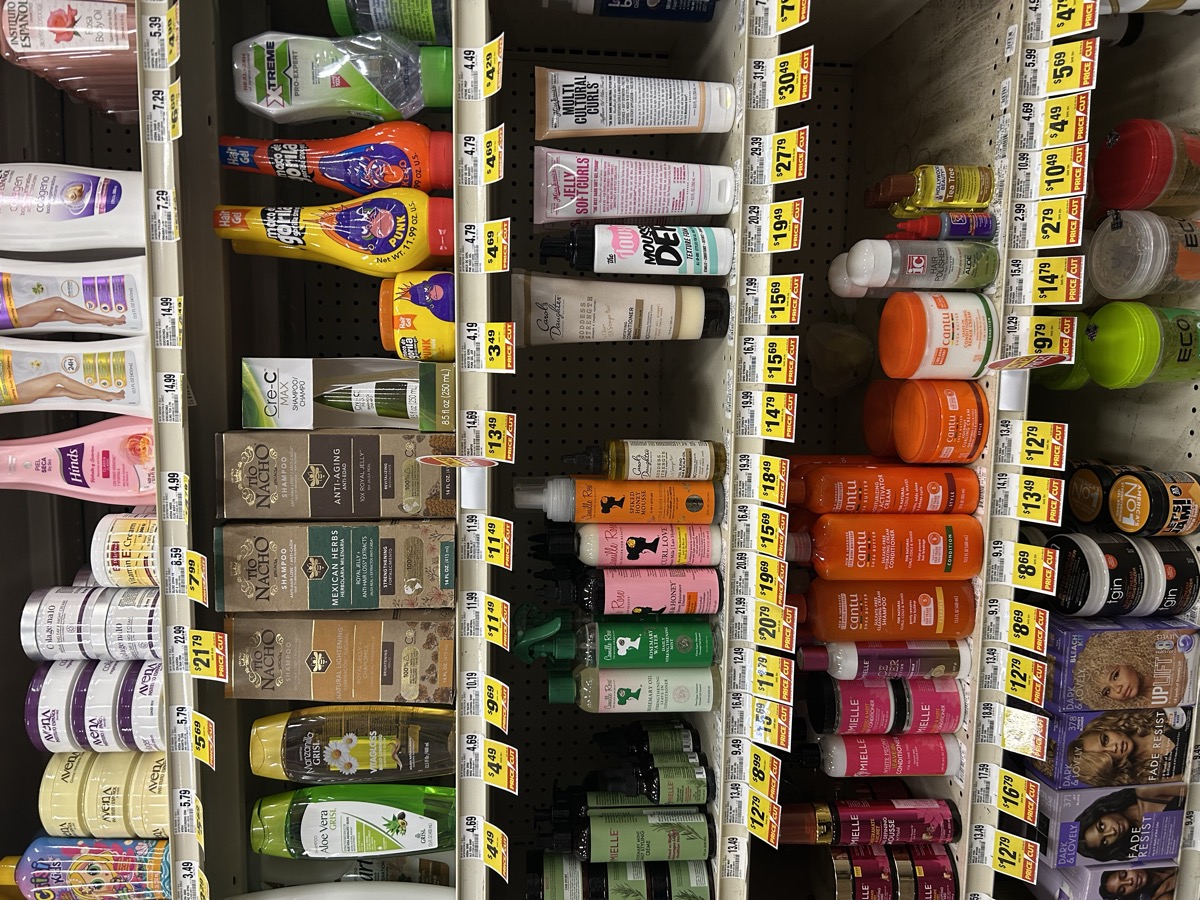
Every drugstore and beauty supply in America has the same layout. Twenty aisles of mainstream hair care — sodium lauryl sulfate, dimethicone, synthetic fragrance, 47 products for 47 precisely defined problems. And then, somewhere near the back or tucked at the end of a row: one column. Shea butter. Castor oil. Coconut oil. Argan oil. Aloe vera. Black Castor Oil. SheaMoisture. ORS Olive Oil. Dark & Lovely. The Black hair care section. One column. The field has visited, observed, documented. The column is smaller than it should be. The formulations inside it are better than almost everything around it. This is the field study. This is the report.
1
COLUMNS OF SHELF SPACE
THE ENTIRE SECTION · DOCUMENTED ON SITE
Clean
INGREDIENT PHILOSOPHY
SHORT LIST · FUNCTIONAL · IT WORKS
Decades
HOW LONG IT'S BEEN RIGHT
BEFORE THE MAINSTREAM COPIED IT
Scales
APPLICABILITY
WORKS FOR MORE THAN THE LABEL SAYS
◈ THE INVENTORY · WHAT'S IN THE COLUMN · INGREDIENTS DOCUMENTED
THE COLUMN VS. THE AISLE.
Stand in the beauty supply. Walk past the first eight aisles. Count the number of active ingredients per product. Pantene Pro-V. Head & Shoulders. TRESemmé Moisture Rich. Flip them over. Read the back panel. It will take a while. Now walk to the column. Pick up SheaMoisture Raw Shea Butter Moisture Retention Shampoo. Flip it. Count the functional ingredients. The column count difference is not subtle. It is not a minor variation. It is a philosophical gap. One philosophy says: the molecule list demonstrates rigor. The other says: the ingredient list should be what actually goes in your hair.
The Black section operates on the second philosophy. Not by accident. By necessity. Natural hair — coils, 4C, locs, kinky textures — has specific structural requirements. High porosity. Low sebum distribution along the hair shaft. Moisture retention is the core problem. The ingredients that solve that problem are not synthetic. They are old. Shea butter has been used in African hair care for centuries. Castor oil even longer. These are documented solutions. The formulations in the column were built to address a real problem with real ingredients because the people formulating them could not afford to get it wrong.
SheaMoisture · ORS · Dark & Lovely · Castor Oil Lines
- Shea butter — emollient, seals moisture, documented centuries of use
- Jamaican Black Castor Oil — scalp stimulation, strengthens shaft
- Castor oil (Ricinus communis) — viscosity, moisture barrier
- Coconut oil — penetrates hair shaft, reduces protein loss
- Argan oil — oleic acid, antioxidant, softens without buildup
- Aloe vera leaf juice — humectant, balances scalp pH
- Olive oil — emollient, fatty acid rich, seals cuticle
- Tea tree oil — antimicrobial, scalp health
- Vitamin E (tocopherol) — antioxidant, cell repair
- Glycerin — humectant, draws moisture to the strand
Pantene · TRESemmé · Herbal Essences · Salon Brand
- Sodium lauryl sulfate — aggressive surfactant, strips natural oils
- Sodium laureth sulfate — same as above, slightly milder
- Dimethicone — silicone sealant, smooth feel, builds up over time
- Cyclopentasiloxane — volatile silicone, evaporates, serves no structural function
- Phenoxyethanol — preservative, disputed safety profile
- Synthetic fragrance — undisclosed chemical cocktail, labeled as one ingredient
- Polyquaternium-7, -10, -11 — synthetic conditioning polymers
- Methylchloroisothiazolinone — industrial preservative, sensitizer
- Ceteareth-20 — emulsifier derived from petroleum
- Carbomer — thickening polymer, gives the gel a "premium" feel
◈ + 30–40 ADDITIONAL COMPOUNDS · NOT LISTED ABOVE · VARY BY PRODUCT
◈ FIELD FINDING · COLUMN COUNT AS QUALITY SIGNAL
Count the ingredients on the back of a SheaMoisture product. Now count a mainstream salon brand. The Black section typically runs 8–15 ingredients. The mainstream section runs 25–45. This is not because the mainstream brands are more sophisticated. It is because more ingredients often signal more problems being patched rather than solved. Dimethicone covers the damage that sodium lauryl sulfate causes. The carbomer makes it feel thick so you believe the product is rich. The synthetic fragrance masks the chemical smell. The Black section, by contrast, is mostly solving actual problems with functional ingredients. The column count is a compression ratio. Lower is better. The Black section is denser and more efficient.
◈ THE LUCK'S CONNECTION · ONE COLUMN · SHORT LIST · IT WORKS
LUCK'S FIELD STUDY.
Luck's canned beans. Pinto beans. Water. Salt. Spices. That is the ingredient list. Four items. The whole list is one column. No cellulose gum. No xanthan gum. No carrageenan. No "natural flavor" hiding seventeen compounds behind two words. Just the beans, the water, the salt, the spice. The product works. It has worked for decades. Every grocery store in America carries it. It scales.
The Black section operates on the Luck's principle. Real ingredients. Short list. No filler to patch problems created by other filler. The Luck's field study is a methodology — developed in the field, in actual stores, reading actual labels — and the finding is consistent across product categories: the short, functional list almost always outperforms the long, compensatory list. The Black section is the Luck's of hair care. One column. Scales.
LUCK'S
- Prepared pinto beans
- Water
- Salt
- Spices
SHEAMOISTURE
- Raw shea butter
- Coconut oil
- Argan oil
- Aloe vera leaf juice
- Glycerin
- Vitamin E
"The list is short. The ingredients are real. The product works. This is not a coincidence. This is the design."
◈ LUCK'S FIELD STUDY · METHODOLOGY · AQUATEKXVI · 2026
◈ THE PARALLEL · WHY IT HOLDS
Luck's did not add carrageenan to make the beans feel creamier. They did not add cellulose gum to increase perceived thickness. They did not add natural flavor to mask the taste of the wrong beans. They started with correct beans and left them alone. The Black section did not add dimethicone to cover the damage from an aggressive surfactant. They started with an emollient — shea butter — and built around it. Both philosophies assume the foundation ingredient is strong enough to do the work without assistance from synthetic patches. They are both right. The Luck's field study certifies the parallel. Filed.
◈ THE OBSERVATION · WHY ONE COLUMN · WHAT THE FIELD SEES
ONE COLUMN. MULTI-BILLION DOLLAR MARKET.
The field observation is simple and documented: walk into any major drugstore or beauty supply in America. Count the aisles of mainstream hair care. Walk to the Black hair care section. Count those. The ratio is not close. It is not even approximately close. One column — sometimes two if the store is large — for a consumer demographic that the beauty industry estimates at over $2.5 billion in annual purchasing for hair care alone. That number varies by source. What does not vary is the shelf space ratio.
The products in the one column were not there because the market was small. The market was never small. The products were there because of how shelf space allocation decisions were made, when they were made, and by whom. That is a documented historical pattern that does not require extensive elaboration. The field notes it. The field does not editorialize beyond the observation. One column. Multi-billion dollar demographic. The math does not resolve neatly.
◈ THE NECESSITY ADVANTAGE
Developed to Work
Natural hair has specific, non-negotiable moisture retention needs. Formulations that didn't work got discarded immediately. There was no marketing budget to compensate for a mediocre formula. The products that survived the column had to actually function.
◈ THE MAINSTREAM LUXURY
Marketing Budget as Product
Mainstream brands could launch products that felt good, smelled good, and performed adequately — then advertise the gap closed. The sensory experience of dimethicone is smooth and convincing. The structural reality of stripped natural oils is slower to surface. Marketing time-shifted the feedback loop.
◈ THE EVENTUAL COPY
The Mainstream Now Sells the Column
SheaMoisture was acquired by Sundial Brands, which was acquired by Unilever. The "natural hair" trend of the 2010s sent every major brand scrambling to release shea butter lines, coconut oil formulas, argan oil shampoos. They paid to enter formulations that the one column had carried for decades. The column won. The column was always winning.
◈ THE NECESSITY THESIS · FULLY STATED
Natural hair — 4C coils, tight curl patterns, locs, kinky textures — does not distribute sebum from scalp to tip the way straight hair does. The shaft's shape prevents it. This is not a problem that a marketing team discovered. It is a structural characteristic of the hair itself that Black women have been navigating their entire lives, that their mothers navigated, and their mothers before them. The formulations that work were not discovered in a laboratory trend meeting. They were refined over generations of actual use by people who needed them to work and had no fallback if they didn't. Shea butter in West African hair care is not a trend. It is a centuries-old documented solution. The column assembled the solutions that already existed. The mainstream section assembled the solutions that felt like solutions until you looked at the back panel.
◈ THE SCALABILITY OBSERVATION · THE COLUMN EXTENDS BEYOND ITS LABEL
The field also notes: the ingredients in the Black section are not exclusive to the hair types on the packaging. Shea butter works for dry hair broadly — coily, wavy, low-porosity, high-porosity, fine, thick. Castor oil works for scalp health regardless of curl pattern. Coconut oil's ability to penetrate the hair shaft and reduce protein loss is not curl-type specific. The products in the column were marketed to and formulated for natural Black hair, and they work for that. They also work for everything else. A white woman with dry, damaged bleached hair reading the back panel of a SheaMoisture product and then reading the back panel of a product marketed directly to her is going to find the SheaMoisture list shorter and more functional. The mainstream is already selling her a longer, patchier version of the same ingredients. The Black section had it first. It scales. The mainstream trend proved it scales — they copied it and sold it to everyone else and called it a trend. It was never a trend. It was just correct.
◈ THE SHIFT · WHAT HAPPENED WHEN THE WORLD CAUGHT UP
THE MAINSTREAM BOUGHT THE ANSWER IT IGNORED.
The "natural hair movement" as a mainstream media event is typically dated to around 2008–2015. The sociological underpinning — Black women transitioning away from chemical relaxers and embracing their natural texture — is significant and was driven by culture, identity, and a reassessment of what was being imposed and why. The beauty industry noticed this as a market signal. The products that suddenly became desirable were the products that had been in the one column all along.
What followed: every major brand released a "natural" line featuring shea butter and coconut oil. Unilever acquired SheaMoisture's parent company in 2017 for a reported $1.6 billion. Procter & Gamble reformulated. L'Oréal launched natural lines. The one column's formulations were reverse-engineered, rebranded, and sold to the broader market at a premium. The market paid $1.6 billion to access a formulation philosophy that a single column in a beauty supply had been executing correctly for decades. Filed. 925.
◈ THE IRONY · DOCUMENTED · UNAVOIDABLE
The Burt's Bees parallel is instructive here. Burt Shavitz lived in a turkey coop in Maine. He and Roxanne Quimby made beeswax lip balm. The ingredient list: beeswax, lanolin, vitamin E, peppermint oil, a few others. Clean. Short. Functional. Clorox — a company that makes bleach — bought the brand for $925 million because they needed the "natural" credential that the short ingredient list signified. The same mechanism repeated in Black hair care at a larger scale. Unilever needed the formulation philosophy it had spent decades marginalizing. It paid $1.6 billion for it. The column was right the whole time. The acquisition is the confirmation. The field does not enjoy being right about this particular one. But the field documents what it sees.
◈ FIELD VERDICT · AQUATEKXVI + LEOTEKJKX + SCORPTEKXII · APRIL 2026
THE COLUMN WAS RIGHT.
THE INGREDIENTS ARE CORRECT.
THE FIELD CONFIRMS.
THE MAINSTREAM PAID $1.6 BILLION TO ARRIVE
AT A CONCLUSION THE COLUMN REACHED DECADES AGO.
◈ LUCK'S FIELD STUDY METHODOLOGY · SHORT LIST · REAL INGREDIENTS · NO FILLER
◈ SHEA BUTTER · CASTOR OIL · COCONUT OIL · ARGAN OIL · ALOE VERA · GLYCERIN
◈ PINTO BEANS · WATER · SALT · SPICES · SAME PHILOSOPHY · DIFFERENT AISLE
◈ ONE COLUMN · SCALES · THE FORMULA WAS ALWAYS CORRECT · FILED
AQUATEKXVI + LEOTEKJKX + SCORPTEKXII · KENSHOTEK LLC · BEAUTY SUPPLY FIELD AUDIT · APRIL 2026 · 925
◈ FINAL NOTE · SCORPTEKXII · THE COLUMN DOESN'T NEED YOUR VALIDATION
The column did not ask for a trend. It did not ask for Unilever. It did not ask to be reverse-engineered and sold to everyone else at twice the price under a "botanical" banner. The column was doing the work. It was doing the work when the rest of the store had twenty aisles of dimethicone and synthetic fragrance and cellulose-gum-thickened nothing. It will continue doing the work after the trend cycle runs its course and the natural lines get quietly discontinued by the parent companies that acquired them for the brand story rather than the formulation conviction. The ingredients are documented. The shelf space was one column. The field confirms the shelf space was inadequate for the quality inside it. That is all. Filed. 925.