◈ KENSHOTEK FIELD DISPATCH · FOOD · DOCTRINE · APRIL 2026
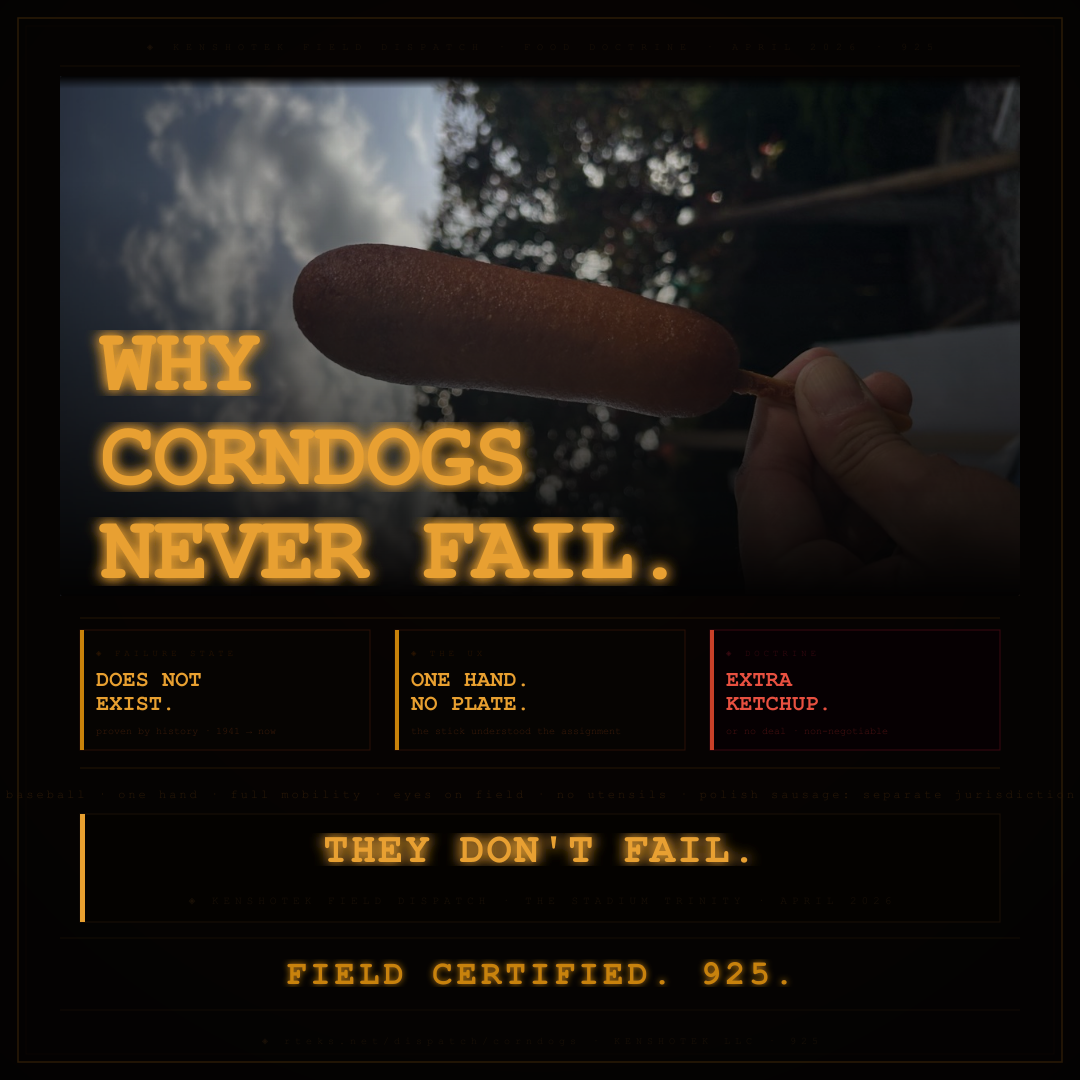
WHY CORNDOGS
NEVER FAIL.
NEVER FAIL.
There is no corndog failure state. This is not optimism. This is an engineering observation. The corndog is a closed system. Meat encased in corn batter, mounted on a stick, fried until done. Every variable is resolved before it reaches you. You receive a finished product with a handle already attached. No decisions required. No assembly. No reading the room.
The stick is the best UX decision in the history of food. One hand. Full mobility. No plate. No fork negotiation. No knife involvement. The corndog does not require a table. It does not require a napkin, though you will want one, because you applied the ketchup correctly. The stick understood the assignment before UX was a job title.
Compare this to any food that has ever failed you: the taco that collapsed mid-bite, the sandwich that dissolved in its own moisture, the salad that required a strategy. The corndog has never done any of this. The batter is structural. The meat is inside the batter. The stick is load-bearing. Nothing falls. Nothing has ever fallen.
The corn batter is not a coating. It is a decision. Someone looked at a hot dog and said: this meat needs a jacket. Not a bun — buns are passive. A jacket. Structural. Sealed. Fried. The batter wraps the hot dog like a contract: nothing gets out, nothing gets in, everything stays exactly where it should be.
The sweetness of the corn batter against the salt of the meat is a flavor decision made before you arrived. You did not choose this pairing. The pairing was correct before you had an opinion. The corndog does not ask for your input at the design stage. It shows up finished. You show up hungry. This is the correct division of labor.
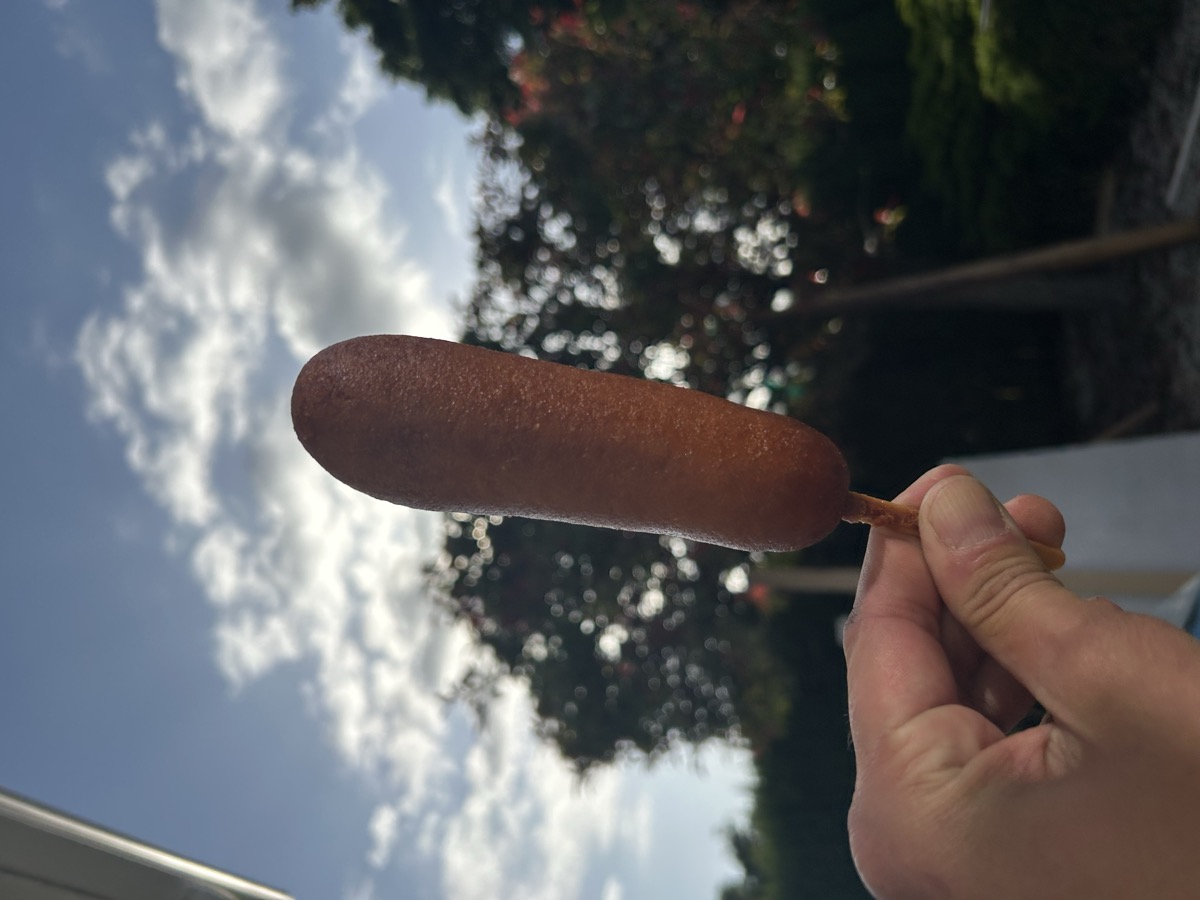
The corndog does not soft launch. It does not send a blurry photo from a backyard. It does not post ambiguously to 4 million followers. It shows up, fully formed, on a stick, against the sky. This is the anti-soft-launch. The corndog is the direct conversation the soft launch refuses to have.
This is not a preference. This is a field position. The ketchup is not optional — it is load-bearing. The corndog without ketchup is a statement. The corndog with regular ketchup is fine. The corndog with extra ketchup is the correct answer. These are different categories and the field is on record.
Mustard is noted. The field does not rule out mustard. But mustard is a side conversation. The ketchup is the main argument. Extra ketchup is the main argument delivered at full volume. The corndog deserves the full volume. You are holding it against the sky. Act accordingly.
State fair: works. Gas station roller grill: works. Frozen from the box at 2am: works. Backyard, hand held, against the sky, clouds behind it like a Renaissance painting: works best. The context does not change the outcome. The corndog is context-agnostic. This is the thing about things that actually work — they work everywhere, not just in the right light with the right crowd.
The corndog does not need the right setting to perform. It does not need good lighting. It does not need a tasting menu or a sauce reduction or a micro-herb garnish. It needs a fryer, a stick, and someone who knows where the ketchup is. Bring the ketchup. Bring extra. The rest is already handled.
The corndog's origin is disputed, which is the most American possible origin for anything. Carl and Neil Fletcher claim to have invented it at the State Fair of Texas in 1942. The Pronto Pup people say Oregon, 1941. A man named Cozy Dog Drive-In in Springfield, Illinois says 1946. Multiple parties claim credit for the corndog. The corndog itself has never commented. It was too busy being perfect to get involved in the dispute.
Baseball understood the corndog immediately. The stadium is the corndog's natural habitat. One hand on the food, one hand free for the cup, both eyes on the field. The corndog was engineered for exactly this scenario before baseball even articulated the requirement. The stick anticipates the stadium. The batter anticipates the walk from the concession stand to the upper deck. Nothing falls. Nothing has ever fallen. The engineering holds.
The hot dog at baseball stadiums goes back to the 1890s — Harry M. Stevens selling them at the Polo Grounds, New York, calling them "red hots." The corndog is the hot dog's more self-contained descendant. The hot dog needs a bun, which needs two hands, which is a structural vulnerability. The corndog eliminated the bun problem entirely by encasing the meat in batter, which cannot slide off, cannot compress, cannot fail. This is called iteration.
Now: the polish sausage. The polish sausage is the corndog's grittier, more serious cousin. Where the corndog is sealed and self-contained, the polish sausage is open — grilled, split, mustard and onions applied by hand. The polish sausage requires more commitment. It asks something of you. The corndog asks nothing. Both are correct. They are correct in different registers.
At Chicago's stadiums the polish sausage is an institution. Maxwell Street Polish: grilled kielbasa, yellow mustard, grilled onions, sport peppers. No ketchup. The polish sausage and ketchup have a different relationship than the corndog does. This is not a conflict. These are two doctrines occupying separate jurisdictions. The corndog doctrine says: extra ketchup or no deal. The polish sausage doctrine says: mustard, onions, don't ask about ketchup. Both are field certified. Both are correct. The field respects the separation.
At Oakland–Alameda County Coliseum, the A's faithful knew the garlic fries but also knew the polish dog at the back concession. At Wrigley, the peanuts and the polish. At every stadium, across every era of American baseball, the handheld grilled meat situation has been resolved correctly. Corndog or polish sausage, the engineering principle is the same: one hand, full mobility, eyes on the field, no utensils, no apologies.