
Kristian Dunn · doubleneck bass · live loop
Tim Fogarty · drums · the engine
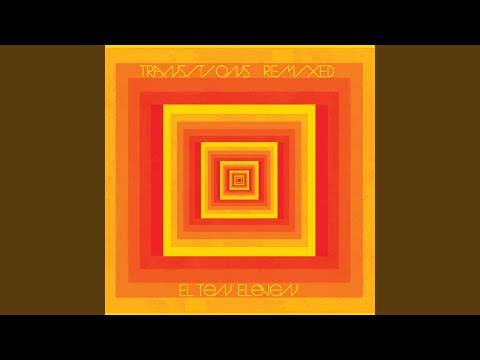
transitions remixed · the dissolution
ravens under no heat · just ebb
El Ten Eleven is two people making a sound that shouldn't be possible with two people. Kristian Dunn plays a doubleneck bass — one neck standard bass, one neck a six-string — running both pickups simultaneously into separate signal chains. The bass line and the melody live on the same body. He loops them live on stage, layer by layer, building the full arrangement in real time before Fogarty's drums arrive.
This is not a trick and it is not a workaround. It is a technical position — a deliberate decision about what kind of music is possible when you refuse to add personnel. The constraint is the method. The limitation generates the form. Every El Ten Eleven track is a loop architecture that could only exist because one person decided to hold both frequencies at once.
The original "Transitions" builds like all El Ten Eleven — loop by loop, the architecture assembling itself in front of you. The bass line arrives first, simple and patient. Then the melody doubles over it. Then another layer. Then another. By the time Fogarty's drums hit, the structure is already load-bearing. The drums don't start the song. They confirm what the loop has already decided.
The feel is forward-moving. There is propulsion in it. The tempo is not aggressive but it has intention — each loop return is a commitment, a decision to stay in the key, stay in the rhythm, keep building. "Transitions" in the original is about the act of crossing over. The process. The movement through. It does not sit. It travels.
The melody has a particular quality Dunn reaches for: it is hopeful without being naive. Post-rock's signature is the instrumental emotional arc — the thing you'd put words to but the words would reduce it. "Transitions" stays instrumental because the transition it describes is not nameable. It is the feeling of something ending and something beginning in the same breath. The song holds both simultaneously — exactly like the instrument does.
under no heat
just ebb"
What Krueger found inside "Transitions" was what the original never had time to show: the quiet that exists inside the loop before the next layer arrives. The remix takes the source material and spreads it out — not slower necessarily, but wider, with more air between the elements.
The original is the river moving. The Krueger Remix is the surface of the same river seen from above, still, the current invisible from that height. The water is the same water. The perspective is everything.
Ravens under no heat. That image is exact. Ravens don't flap constantly — they catch thermals and ride. No heat means no thermal. Which means the flight is pure wing, pure glide, pure the-body-knowing-what-to-do. The Krueger Remix flies like that: no updraft pushing it, no percussion driving it, just the melody sustaining itself on its own aerodynamics.
Just ebb. Not flow. Ebb. The tide going out. The remix doesn't build to something — it recedes into something. Every loop return in the original was a decision to add. Every moment in the Krueger Remix is a decision not to add. That restraint is the composition. The space is the content.
A great remix doesn't replace the original. It answers a question the original raised without knowing it was raising it. El Ten Eleven's "Transitions" asks: what does it feel like to cross over? Krueger's answer: it feels like this. Still. Open. Held.
You cannot fully hear "Transitions" until you have heard the Krueger Remix. Once you know what Krueger found inside it — the atmospheric core, the suspended melody, the version that exists when the percussion is removed — you hear that core present in the original all along, running underneath the loops.
The original is not the finished statement. Neither is the remix. They are two readings of the same text. The original is the text read aloud, with rhythm and momentum. The Krueger Remix is the same text read silently, in a room, after everyone has left. Both readings are correct. They illuminate each other.
This is what great source material allows: multiple true versions. Not covers, not interpretations in the sense of distortion — actual different truths that exist simultaneously in the same piece of music. Dunn and Fogarty built something capacious enough to hold both the drive and the ebb. Krueger found the ebb. That required the original to have put it there.
ONE INSTRUMENT. TWO VOICES.
THE ORIGINAL: THE DRIVE. THE CROSSING.
THE KRUEGER REMIX: THE EBB. THE AFTERMATH.
RAVENS UNDER NO HEAT. JUST EBB.
LISTEN TO BOTH. THEN LISTEN AGAIN.
"IF YOU UNDERSTAND YOU DO.
IF YOU DON'T — YOU STILL DO."
FIELD CERTIFIED. 925.