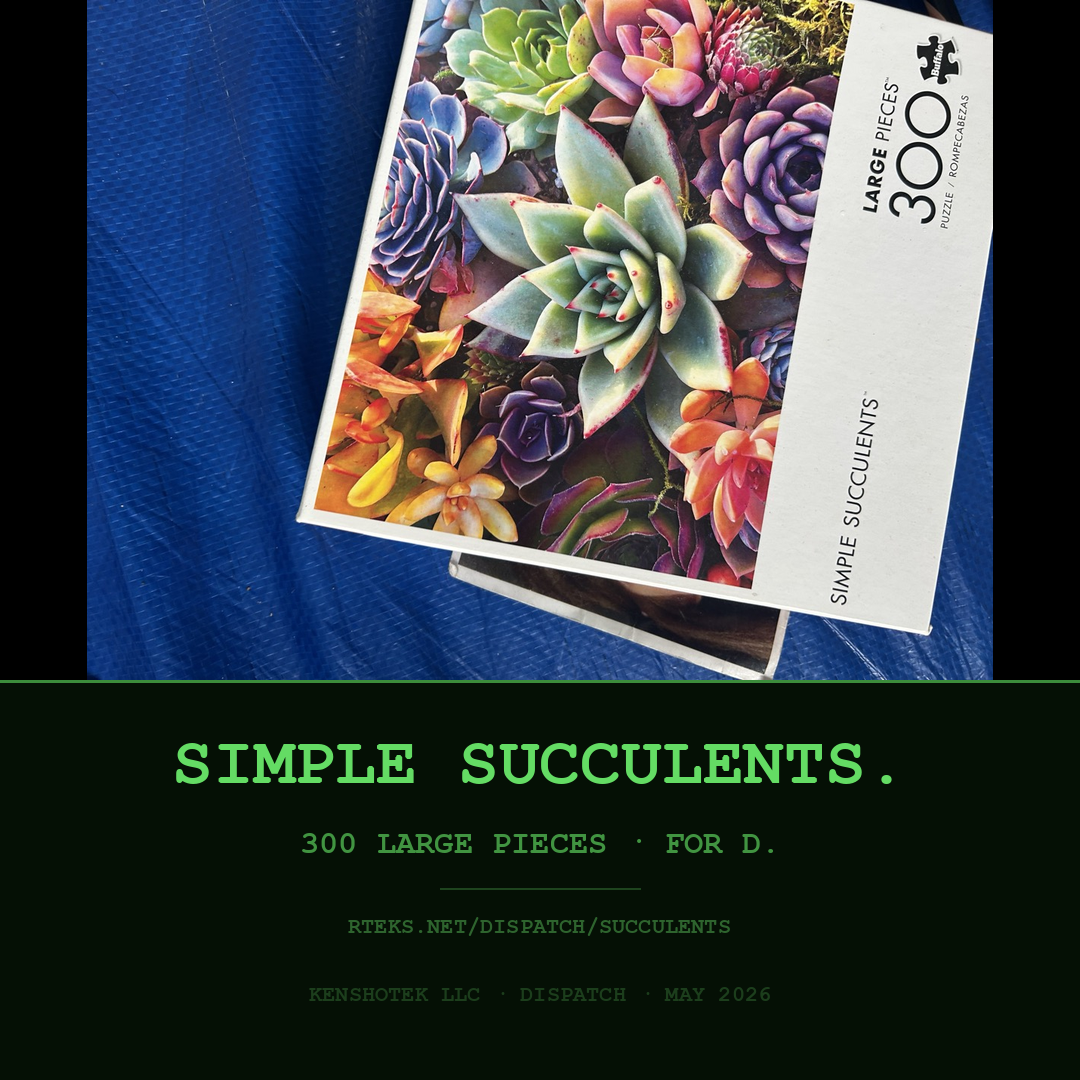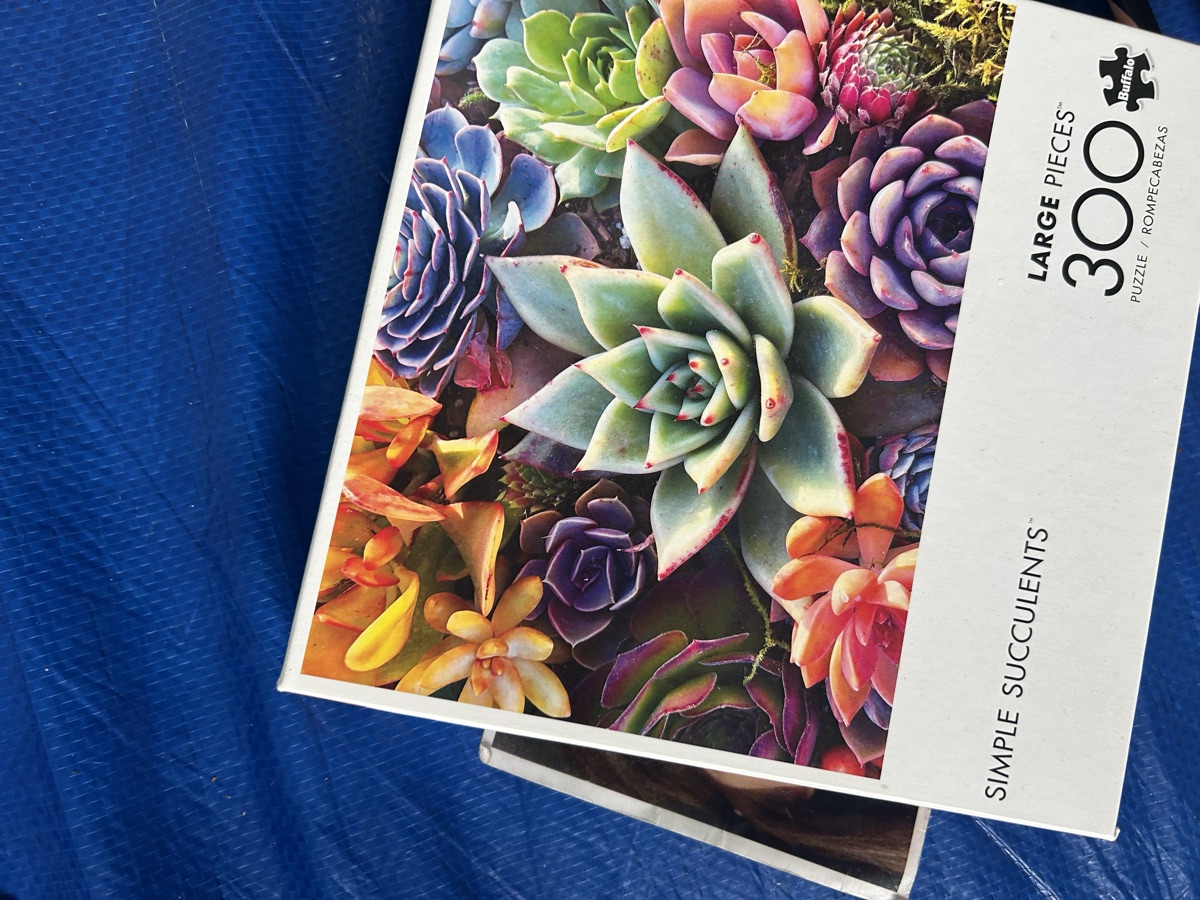
That is a puzzle box. 300 large pieces. The image on the box: succulents — tightly packed, saturated color, every variety stacked against every other variety in a composition that is almost overwhelming in its density. Simple Succulents. The name of the puzzle. The name is not ironic. The succulents are genuinely simple. The puzzle is genuinely a puzzle. Someone decided that the thing most worth assembling in 300 pieces was a picture of the plants that need the least from you. This is either the most relaxing puzzle ever made or the most conceptually loaded one. Probably both.
The object in that image contains everything this dispatch is about. It is simultaneously a succulent and a puzzle. It requires patience to complete and celebrates a subject that embodies patience. When you finish the puzzle you will have assembled, piece by piece, a picture of organisms that require almost nothing from you. The irony is the point. You spent three hours with full focus constructing an image of the thing that asks nothing of you. That is not wasted time. That is the definition of restorative time. The puzzle asked. You answered. The succulents in the picture had no opinion about any of it.
A succulent stores water in its leaves. That's the whole move. The environment becomes hostile — drought, heat, months with nothing — and the succulent is fine because it planned ahead at the cellular level. It doesn't panic when the water stops. It already has the water. It stored it when the water was available and has been spending it strategically ever since. This is not a survival tactic. This is a philosophy. The succulent figured out in the Cretaceous period what most humans are still trying to learn: hold your resources in yourself, not in the conditions around you.
The succulent thrives in neglect. This is not a metaphor — it is literally true and it is also a metaphor. Most houseplants die when you ignore them. The succulent dies when you pay too much attention. Water it every day and you kill it. Fuss over it, move it, repot it every month, adjust its conditions constantly — you kill it. The succulent requires that you back off. It requires a specific kind of trust: the trust that it knows what it's doing and your intervention is the problem. The anxious plant owner and the succulent are incompatible. The anxious plant owner overwatered it. The succulent didn't survive the love.
One fallen leaf on dry dirt becomes a new plant. The propagation is the argument. Not just survival — regeneration from almost nothing. A single leaf. No roots yet. No stem. Just a leaf on the ground and the intention to continue. Given time — weeks, months — a full plant emerges from the edge of that leaf. No assistance required. No special soil. No grow light. Just: the leaf, the dirt, the patience of not interfering. The succulent is the most self-reliant organism most people will ever own. It is teaching a class and most people are not attending.
A puzzle is a complete picture broken into pieces. Someone took something whole and shattered it deliberately, put the pieces in a box, and charged you money to put it back together. This is insane and also the best possible use of an afternoon. The puzzle is the only activity where the goal is clearly defined, entirely achievable, requires zero talent or training, and cannot be rushed. You cannot be better at puzzles than you are. You can be more experienced. You cannot be faster than the pace the puzzle sets. The puzzle does not care about your IQ. The puzzle cares about your patience.
Everyone does the border first. Always. Nobody decided this — it emerged from collective human wisdom across millions of puzzle sessions. You establish the frame before you fill the interior. You find the edge pieces, you build the boundary, you create the container, and then you work inward. This is also how you build a company, a relationship, a self. The border is the constraint that makes the work possible. Without the frame, you are just pushing pieces around a table. The frame is not the limitation. The frame is the foundation.
The moment when the pieces start clicking — not the first click, the tenth — is the moment your brain recalibrates. It stops looking at pieces and starts seeing patterns. It stops consciously searching and starts recognizing. This is the same thing that happens when you get good at anything. The succulent grower stops counting days between waterings and starts reading the leaves. The puzzle solver stops reading the picture on the box and starts trusting their hands. The conscious effort becomes embodied knowledge. You stop doing the thing and start being someone who does the thing. There is no shortcut to this. The puzzle does not offer shortcuts. That is the whole point of the puzzle.
The succulent and the puzzle are teaching the same thing from different angles. Patience is not waiting. Patience is active, intelligent, sustained attention at low intensity over long time. It is the opposite of passivity. The passive plant owner ignores the succulent and it thrives. The passive puzzle solver puts it away and never finishes it. The patient version is different: the patient plant owner checks the soil, reads the leaves, backs off when backing off is correct, and the plant thrives. The patient puzzle solver keeps coming back, trusts the emerging pattern, stays in the not-knowing until the knowing arrives.
Both teach you to hold uncertainty without collapsing it prematurely. The succulent says: the drought is temporary, I have resources, I will not panic into overconsumption. The puzzle says: I do not know where this piece goes, I will set it aside, the pattern will show me later. The anxious mind cannot do either of these things. The anxious mind waters the succulent daily because the soil looks dry. The anxious mind forces the piece because it almost fits. The almost-fit kills the puzzle the same way the daily watering kills the plant. The piece you forced is now stuck in the wrong place and it costs you twenty minutes to undo it. The succulent you overwatered has root rot that takes three months to kill it. The damage from anxiety is always disproportionately larger than the risk that triggered the anxiety.
Nobody has ever finished a puzzle angry. This is a documented fact of lived experience even though no one has documented it. You start a puzzle in whatever state you're in. By the time the final piece clicks into place, you are different. The puzzle required sustained low-intensity focus for hours. That kind of focus is a meditation whether you intended it or not. The nervous system reset. The loop quieted. The final piece is not just the completion of the puzzle. It is the evidence that you sat with something uncertain for long enough that it resolved. That's the practice. The puzzle is the delivery mechanism.
The succulent on the windowsill is not decoration. It is a demonstration. It is showing you how to exist in an environment that is not always giving you what you need. It stored the water when the water was there. It is spending it wisely now. It did not know a drought was coming. It is always ready for a drought. It is always ready for abundance. It adjusts with zero drama. It does not post about its journey. It does not require validation. It sits on the windowsill and continues.
The puzzle on the table is not a hobby. It is a practice. It is the daily evidence that not-knowing resolves into knowing if you stay with it. The piece you couldn't place at 2pm clicks at 4pm because your pattern recognition matured in the interval. The drought-adapted leaf that fell from the plant in October is a full succulent by March. You didn't do anything. You stayed. You didn't interfere. You trusted the process and the process delivered. The process always delivers if you stop forcing it.
Here is what GoldenTek adds, for D: the succulent is a love language for people who don't trust themselves to sustain love. It says: I want something alive in my space but I know my attention is inconsistent and I respect this plant enough to choose one that won't punish me for being human. That is not laziness. That is self-knowledge. That is the beginning of wisdom. And the puzzle — the puzzle is a love language for people who need to believe the whole picture exists before they can see it. You do a puzzle because you know the image on the box is real. You know the pieces add up. You just can't see it yet. You do the puzzle as an act of faith in the coherence of the thing. That's not a hobby. That's a worldview. Both of these things — the succulent on the shelf and the puzzle on the table — are someone telling you who they are without saying a word.
between us fam. 925.
they petty.
we sneeze on em.