◈ FIELD DOCUMENTATION · NATURAL HISTORY · PINOLE CA · MAY 2026
THEY WERE
HERE FIRST.
MELEAGRIS GALLOPAVO · WILD TURKEY · PINOLE CA · CONTRA COSTA COUNTY
5 MILLION YEARS IN NORTH AMERICA · 150 YEARS OF US · THEY KNOW THE MATH
NOT LOST · NOT CONFUSED · ON THEIR ROUTE · ON THEIR LAND · 925
5 MILLION YEARS IN NORTH AMERICA · 150 YEARS OF US · THEY KNOW THE MATH
NOT LOST · NOT CONFUSED · ON THEIR ROUTE · ON THEIR LAND · 925
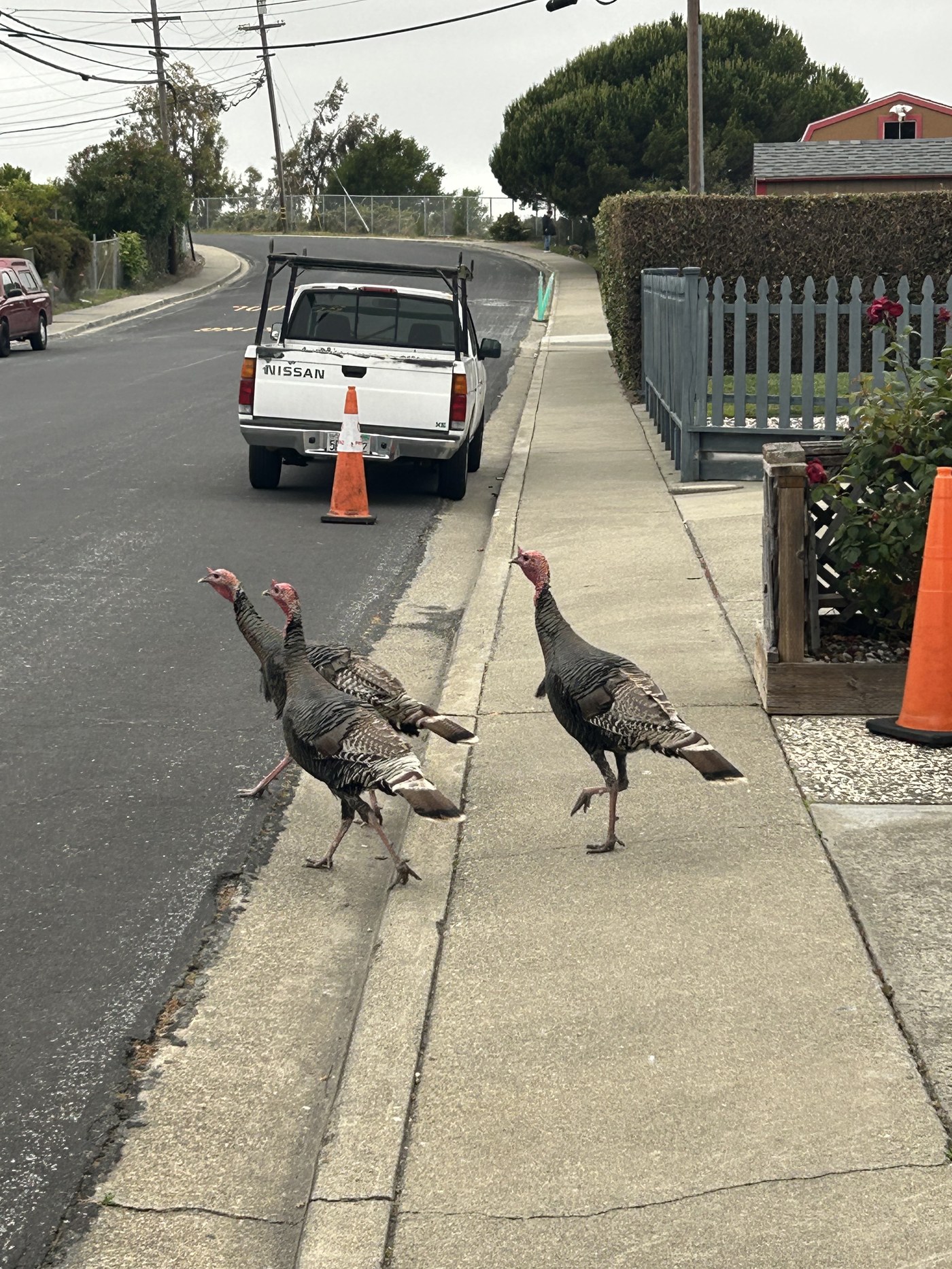
PINOLE, CA · ARTHUR RD AREA · MAY 2026 · Three wild turkeys on patrol. They are not lost. The Nissan is the anomaly. Filed by AquaTekXVI.
Three wild turkeys. Sidewalk. Pinole. Not hurrying. Not stopping. Not even looking at you. They have somewhere to be — the same place they have been going every morning for longer than any street in Contra Costa County has had a name. We built the sidewalk through their commute. The commute predates the sidewalk by several million years.
This is not a cute animal story. This is a land use story. A biological continuity story. A story about what was here before the zoning maps and what is still here despite them. The turkeys are not wildlife intruding into the suburb. The suburb is infrastructure that got built in the turkey's habitat while they were foraging one ridge over.
◈ THE EVOLUTIONARY RECORD · WHERE THEY CAME FROM
Wild turkeys are not barnyard animals that escaped. They are not the dumb fat birds you see at the grocery store. Domestic turkeys and wild turkeys share a name and nothing else. Wild turkeys are lean, fast, intelligent, territorial, spatially aware animals with 270-degree color vision, the ability to see ultraviolet light, and the navigational memory of an animal that has been doing this for five million years.
~66 MILLION YA
K-Pg extinction event. Asteroid. 75% of all species eliminated. Theropod dinosaurs are wiped out — except for one lineage of feathered theropods that survives the impact. That lineage becomes birds. Turkeys are in that lineage. They survived the thing that killed T. rex. Let that land.
~40 MILLION YA
Galliformes diverge. The order that includes pheasants, grouse, peacocks, and turkeys branches off from other birds. They are already ground-foraging, seed-eating, socially complex birds at this point.
~5 MILLION YA
Meleagris gallopavo emerges in North America. The wild turkey as a species is established. North America is their continent. Their range: from southern Canada to central Mexico, coast to coast. 5 million years of occupancy. That is the tenure on record.
~2,000 YA
Mesoamerican domestication. Indigenous peoples in what is now Mexico domesticate the turkey for food and feathers. The Aztecs keep them in temple courtyards. The Spanish bring domestic turkeys to Europe in the 1500s. Europe calls them "Turkey birds" thinking they came from the Ottoman empire (they did not). The name sticks.
1782
Ben Franklin's preference, documented. He writes to his daughter that the bald eagle is "a Bird of bad moral Character" and that the turkey is "a much more respectable Bird" — courageous, though "a little vain and silly." He never formally proposed it as the national bird but the sentiment was real. The field respects Franklin for this.
1900s
Near extinction due to hunting + habitat loss. Wild turkey population drops to approximately 30,000 birds across the entire United States. Near-total wipeout of a species that had existed for 5 million years, accomplished in about 150 years of colonization and market hunting. Classic.
1930s–1970s
Recovery program. Wildlife agencies trap-and-transfer wild turkeys to repopulate native range. Slow, expensive, works. Population begins rebuilding. California receives Rio Grande subspecies birds starting in the 1960s-70s — released in foothill habitat throughout the state, including exactly the kind of oak woodland chaparral zone that is Pinole, CA.
TODAY
7 million wild turkeys in North America. Thriving in suburban-adjacent habitat across the Bay Area, Contra Costa County, and most of the eastern US. The species came back from 30,000. Filed as a conservation success. They are walking your street to prove it.
◈ PINOLE SPECIFICALLY · WHY THESE BIRDS SPECIFICALLY
Pinole is in West Contra Costa County. The city sits between San Pablo Bay and the Pinole Ridge — a chaparral and oak woodland ridge that runs through the hills directly above town. That ridge is textbook wild turkey habitat. Blue oak savanna. Valley grassland. Riparian corridors. Acorn-producing valley oaks. Blackberry thickets. All of it, right there, running directly into the residential streets.
The turkeys don't come down from the hills looking for food. The hills and the streets are one continuous territory to them. There is no conceptual boundary between "the wild" and "the suburb" in a turkey's navigational memory. The ridge where they roost connects directly to the streets where they forage. They have been walking this terrain in one form or another for millions of years. The pavement is six inches deep. The habitat is geological.
◈ TERRITORY MATH · PINOLE TURKEY RANGE
Daily forage range: 2–3 miles
A turkey flock covers 2–3 miles every day in a learned, repeating circuit. Same route. Same timing. Same stops. They have memorized the territory.
Home range: 370–1,000+ acres (varies by season)
Hens with poults: tighter range. Toms in breeding season: expanded range. Non-breeding flocks: consistent, predictable circuits.
Pinole tenure: ~5,000,000 years (species) vs ~150 years (city)
The math is not ambiguous. One of these parties is the visitor.
◈ FIELD NOTE · KENSHOTEK
The three turkeys in this photo are not wandering. They are not "straying into" the neighborhood. They are on their route. They walk this block every morning. The residents have adjusted their schedules to account for them. The turkeys have not adjusted anything. This is the correct power dynamic.
◈ BIOLOGY BRIEFING · WHAT YOU'RE ACTUALLY LOOKING AT
270°
FIELD OF VISION · COLOR · UV CAPABLE
55 mph
FLIGHT SPEED · SHORT BURST · YES THEY FLY
~18 lbs
WILD TOM · FIELD WEIGHT
25 mph
RUNNING SPEED
3–5 yrs
WILD LIFESPAN · UP TO 12 PROTECTED
28 calls
DISTINCT VOCALIZATIONS
5M yrs
NORTH AMERICAN RESIDENCY
7M
CURRENT NORTH AMERICAN POPULATION
The birds in the photo are almost certainly hens — slimmer body, no beard visible, no full fan-tail display. Wild hens move together in non-breeding groups through established territory. They are not feral. They are not escaped. They are wild animals doing exactly what wild animals of their species do, in the exact habitat type their species is adapted for. The adaptation just happens to now include navigating residential sidewalks, and they have figured that out without any assistance from us.
Wild turkeys can recognize individual human faces. Research at UC Davis has documented turkeys learning which specific people are associated with food and which are associated with threats. If you have seen these birds before, they have also seen you before. They remember.
◈ THE SIX TURKEY SUBSPECIES · FOR THE RECORD
RIO GRANDE
Texas, Oklahoma, Kansas. Introduced: California, Washington, Oregon, Hawaii. This is the Pinole bird. Released in CA hills by CDFW 1960s–70s.
Adapted to semi-arid scrubland and open oak woodland. The Bay Area hills are basically perfect. They took immediately.
EASTERN
East of the Mississippi. Most numerous subspecies — roughly 5.1 million birds. The turkey of Thanksgiving folklore.
Largest body size. Dense hardwood forest habitat. The bird your great-great-grandparents were referring to.
MERRIAM'S
Rocky Mountain West. Colorado, Montana, Wyoming. High elevation ponderosa pine habitat.
Mountain bird. Migrates vertically with season rather than horizontally. Adapted to altitude. Lighter color than other subspecies.
OSCEOLA
Florida peninsula only. Smallest range of any subspecies. Swamp and palmetto habitat.
Darker iridescence. Slightly smaller than Eastern. Found only in Florida. Consider it the Floridaman of subspecies.
GOULD'S
Sonoran Desert region. Southern Arizona, New Mexico, northern Mexico. Most endangered subspecies.
Largest feet and tail feathers of any subspecies. Recovered from near-extinction through binational Mexico-US conservation program.
SOUTH MEXICAN
Southern Mexico only. The original domesticated subspecies — ancestor of every Thanksgiving turkey ever produced commercially.
The original. Mesoamerican peoples selected this bird for domestication ~2,000 years ago. Everything that came after traces here.
◈ WHAT THEY EAT · WHY PINOLE WORKS
The Pinole hills and surrounding residential areas are an inadvertent turkey cafeteria. The diet of a wild turkey is almost entirely supplied by the Bay Area's native and ornamental landscape:
◈ TURKEY DIET MATRIX · PINOLE AVAILABILITY
ACORNS → primary caloric staple
Valley oak and blue oak throughout Pinole ridgeline. One mature oak produces ~20,000 acorns per year. A single turkey can consume 1 lb of acorns per day. The math is favorable.
BERRIES + SEEDS → supplement
Blackberry (Rubus ursinus), toyon berries, wild grape, coyote brush seeds — all present in Pinole Valley. The landscaping also helps: ornamental berry shrubs in front yards are just foraging stations from the turkey's perspective.
INSECTS + INVERTEBRATES → protein
Grasshoppers, beetles, earthworms, slugs. Especially important for poults (chicks). Lawn turf is excellent insect habitat — another reason residential areas work well for them.
SMALL VERTEBRATES (occasional) → opportunistic
Lizards, frogs, small snakes. Not primary prey but absolutely taken when encountered. Wild turkeys are omnivores. Do not be fooled by the Thanksgiving image.
◈ FIELD NOTE · THE PREDATOR SITUATION
Wild turkeys have natural predators: coyotes, bobcats, mountain lions, great horned owls (taking poults), foxes. All of these exist in the Pinole hills. But here's what also exists in the residential zone: no hunting, reduced predator pressure, reliable food, warm asphalt for thermal regulation in the morning. The suburb is not a bad deal for a turkey. They have done the analysis. The analysis took approximately thirty years of trial and error and now they just walk the sidewalk every morning because it is empirically correct behavior.
◈ THE TERRITORY POINT · WE ARE IN THEIR ENVIRONMENT
Here is the framing that most people miss: We think of wild animals in the suburbs as animals that came into our space. This is backwards. The suburb came into their space. The turkeys did not migrate into Pinole. Pinole was built in the middle of a turkey's habitat range. The chaparral, the oak woodland, the grassland — all of that was there first, occupied by the turkeys and every other native species. The subdivision platted over the top of it.
The turkeys aren't adapting to us. We built our infrastructure in the path they were already walking. The sidewalk runs through their forage circuit. The street crosses their morning route. The parked Nissan is a landscape feature they have learned to go around, the same way they learned to go around boulders before there were Nissans.
"The question is not whether wild animals belong in our neighborhoods. The question is whether our neighborhoods belong in their territory — and the honest answer is that our neighborhoods were built in their territory, which makes the question answer itself."
— AQUATEKXVI · KENSHOTEK · FIELD OBSERVATION · PINOLE 2026
California has been doing this across every species. The mountain lions that occasionally appear in Contra Costa County backyards are not invading. They are navigating the land they have always navigated, which now has houses on it. The coyotes that trot through Lafayette are not strays. The red-tailed hawks that perch on the Pinole shopping center light poles are not lost. They are using the landscape the way they evolved to use it, because the landscape still is what it always was, under the concrete. The concrete is three inches deep. The habitat is three million years deep.
◈ THE FUNNY PART · BECAUSE THERE IS A FUNNY PART
◈ FIELD OBSERVATIONS · IN ORDER OF ABSURDITY
1. Wild turkeys are famously unbothered by cars. Multiple Bay Area cities have documented turkeys stopping traffic on residential streets and simply waiting until they were done. Not until the car left — until the turkey was finished. This is an animal that survived an asteroid impact. It is not afraid of a Nissan.
2. Male turkeys (toms) will attack their own reflection in car paint. Parked cars get regularly assaulted in turkey-dense neighborhoods. Turkeys see a rival tom in the door panel. They fight it. Every day. The car never wins. The turkey never learns. This is either extremely dumb or extremely consistent — the field cannot decide.
3. Turkeys roost in trees at night. Thirty-pound birds. In trees. If you have never seen a wild turkey land in an oak tree at dusk, you have a gap in your visual education that this dispatch cannot fill but can document exists.
4. Ben Franklin described the wild turkey as "though a little vain and silly, a Bird of Courage" that "would not hesitate to attack a Grenadier of the British Guards who should presume to invade his Farm Yard with a red Coat on." This is accurate field reporting. The turkey will run up on you. It has happened. It will happen again.
5. The three turkeys in this photo are walking in perfect single file. This is not incidental. Turkeys move through terrain in line formation — the lead bird navigates, the others follow the established path. They invented the follow-the-leader protocol before we had software for it. No latency. No bugs. Been running for five million years.
2. Male turkeys (toms) will attack their own reflection in car paint. Parked cars get regularly assaulted in turkey-dense neighborhoods. Turkeys see a rival tom in the door panel. They fight it. Every day. The car never wins. The turkey never learns. This is either extremely dumb or extremely consistent — the field cannot decide.
3. Turkeys roost in trees at night. Thirty-pound birds. In trees. If you have never seen a wild turkey land in an oak tree at dusk, you have a gap in your visual education that this dispatch cannot fill but can document exists.
4. Ben Franklin described the wild turkey as "though a little vain and silly, a Bird of Courage" that "would not hesitate to attack a Grenadier of the British Guards who should presume to invade his Farm Yard with a red Coat on." This is accurate field reporting. The turkey will run up on you. It has happened. It will happen again.
5. The three turkeys in this photo are walking in perfect single file. This is not incidental. Turkeys move through terrain in line formation — the lead bird navigates, the others follow the established path. They invented the follow-the-leader protocol before we had software for it. No latency. No bugs. Been running for five million years.
◈ SIX AXIOMS
I
They were here first. Not figuratively. Literally. Five million years of North American residency versus 150 years of Pinole. The math does not support the idea that the turkeys are out of place.
II
They are not lost. They are on their route. Wild turkeys have memorized foraging circuits that repeat daily for years. What looks like random wandering is a learned, optimized path through a familiar landscape. The sidewalk is a waypoint, not a mistake.
III
Suburban habitat is habitat. The turkeys didn't come into the neighborhood. The neighborhood came into their territory. The distinction matters. One is an intrusion. The other is not.
IV
They survived the asteroid. Wild turkeys — through their dinosaur ancestors — survived the extinction event that killed 75% of all life on Earth. They recovered from 30,000 birds to 7 million in less than a century. The Pinole sidewalk is not a challenge to them. Nothing we have built is a challenge to them.
V
270-degree UV color vision. They can see things you cannot see. They have already assessed you. They found you acceptable enough to walk past. Consider this a review. Consider what it means that they gave you a pass.
VI
The habitat is three million years deep. The concrete is three inches. Under every street in Pinole is the original substrate: oak woodland, grassland, chaparral. The turkeys know this. They are walking on the memory of it. So are we — we just forgot.
THEY ARE NOT LOST.
THEY ARE ON THEIR ROUTE.
THEY WERE HERE BEFORE THE STREET WAS.
BEFORE THE CITY WAS.
BEFORE THE MAP WAS.
5 MILLION YEARS IN NORTH AMERICA.
SURVIVED THE ASTEROID.
SURVIVED THE MARKET HUNTERS.
NOT INTERESTED IN YOUR CAR.
PINOLE IS IN THEIR TERRITORY. NOT THE OTHER WAY AROUND.
THE HABITAT IS GEOLOGICAL. THE CONCRETE IS DECORATIVE.
FILED. 925.
THEY ARE ON THEIR ROUTE.
THEY WERE HERE BEFORE THE STREET WAS.
BEFORE THE CITY WAS.
BEFORE THE MAP WAS.
5 MILLION YEARS IN NORTH AMERICA.
SURVIVED THE ASTEROID.
SURVIVED THE MARKET HUNTERS.
NOT INTERESTED IN YOUR CAR.
PINOLE IS IN THEIR TERRITORY. NOT THE OTHER WAY AROUND.
THE HABITAT IS GEOLOGICAL. THE CONCRETE IS DECORATIVE.
FILED. 925.
◈ AQUATEKXVI · KENSHOTEK LLC · NATURAL HISTORY DISPATCH · PINOLE CA · MAY 2026 · 925