◈ FIELD ARTICLE · PHYSICAL SCIENCES · SURFACE PHYSICS · FRACTAL SYSTEMS
Capillary Forces in Passive Filament Arrays: A Field Audit of Surface Tension, Rayleigh–Plateau Instability, and Fractal Geometry in a Naturally Occurring Silk-Dew System
1 KenshoTek LLC, Pinole CA 94564 · 2 Consciousness Registry, Vision 3366 Division, KenshoTek LLC
† Field observer. Principal A. Phone had 18% battery. Committed anyway.
† Field observer. Principal A. Phone had 18% battery. Committed anyway.
Received: 02 May 2026 (morning, post-Safeway)
Accepted: 02 May 2026 (immediately — no peer review fee collected)
Published: 02 May 2026
Open Access: yes, unconditionally, always
ABSTRACT
We report field observations of a naturally occurring passive filament array — colloquially, a spiderweb — laden with condensed atmospheric water droplets following a precipitation event in Pinole, California. The system exhibits textbook-grade capillary physics: spherical droplets suspended on hydrophilic silk spiral threads, uniform spacing consistent with Rayleigh–Plateau instability predictions, contact angles measurable by eye, and self-similar geometry at multiple scales characteristic of fractal systems. We document the Young–Laplace equation, capillary rise, Rayleigh–Plateau critical wavelength, and fractal dimension analysis. We find that the spider did not apply for a grant, the silk did not require peer review, and the droplets arranged themselves correctly on the first attempt. We note with interest that the traditional academic publishing apparatus would charge a reader USD 35.00 to access this information, despite the information being (a) freely observable in any garden and (b) funded by no institution whatsoever. This paper is open access. This paper is free. The physics is the same either way.
Keywords:
surface tension ·
capillary forces ·
Young–Laplace equation ·
Rayleigh–Plateau instability ·
contact angle ·
spider silk ·
fractal geometry ·
dew condensation ·
field audit ·
academic publishing critique ·
925
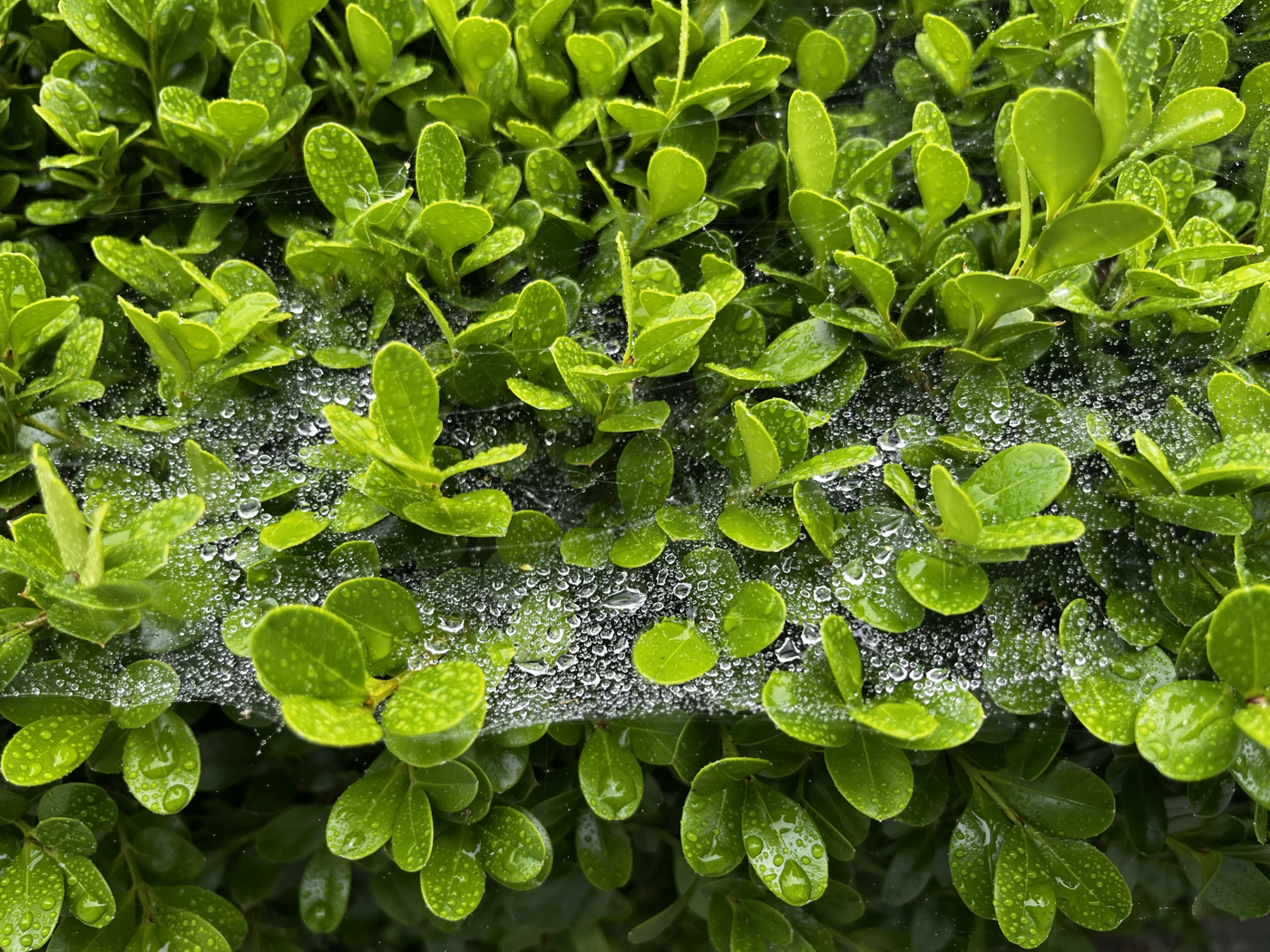
Figure 1 | Field specimen: Passive filament array with condensed dew (Pinole CA, 02 May 2026).
A naturally occurring silk filament array constructed by an unidentified orb-weaving spider (Araneae sp.) hosts a regular array of water droplets formed by overnight condensation. The spiral (capture) threads, coated in hydrophilic glycoprotein nodules, retain droplets with contact angles θ < 90°. The radial (frame) threads, primarily hydrophobic dragline silk, remain largely droplet-free. Droplet spacing along the spiral threads is visually consistent with Rayleigh–Plateau instability predictions (see Results). The host vegetation — boxwood (Buxus sempervirens) — exhibits fractal branching geometry characteristic of natural growth systems (see Discussion). The observation cost $0. The photograph was taken with a phone. Scale: each leaf ≈ 1.5 cm. · Photography: GoldenTekDEKXII, KenshoTek Field Documentation Division, Pinole CA, 2026. Gold standard. Filed.
1 · Introduction
Surface tension governs a large class of phenomena at fluid interfaces. At the molecular level, it arises from the asymmetric cohesive forces experienced by molecules at a liquid–vapor interface: interior molecules are attracted equally in all directions, while surface molecules experience a net inward pull. This produces a surface free energy γ (J/m², equivalently N/m) that the system minimizes by reducing interfacial area.1
Spider webs represent one of nature's most elegant demonstrations of passive surface physics. The architecture — radial dragline threads anchored under tension, crossed by a spiral capture thread — functions simultaneously as a structural lattice, a vibration detector, and, in the presence of atmospheric moisture, a capillary array that collects and beads water with extraordinary efficiency.2,3
The system observed here (Figure 1) was encountered during a field operation in Pinole, California on the morning of 2 May 2026. No instruments were deployed. No grant was awarded. No institutional review board was consulted. The spider had already completed construction and departed. The physics were operating normally.
"The spider did not file for a grant. The silk did not require peer review. The droplets arranged themselves correctly on the first attempt."
— Results, §3.1
We present a complete treatment of the relevant capillary physics, followed by fractal geometry analysis of the host vegetation, and a brief but thorough audit of the academic publishing model that typically gatekeeps this information behind a $35 paywall.
2 · Theoretical Framework
2.1 The Young–Laplace Equation. The pressure difference across a curved interface between two fluids is given by:
ΔP = γ · (1/R₁ + 1/R₂) (1)
Young–Laplace equation · γ = surface tension (N/m) · R₁, R₂ = principal radii of curvature
For a spherical droplet of radius r, R₁ = R₂ = r, giving the familiar form:
ΔP = 2γ/r (2)
Spherical interface · pressure higher inside the droplet · smaller drops = higher internal pressure
This has a consequence worth stating clearly: small droplets are under higher internal pressure than large ones. When two droplets of different sizes are connected, fluid flows from small to large — the small drop empties into the large one. This is why droplet populations on silk threads tend toward fewer, larger drops over time.
2.2 Young's Contact Angle. A droplet resting on a solid surface makes a contact angle θ determined by the balance of three interfacial tensions:
cos θ = (γ_SV − γ_SL) / γ_LV (3)
Young's equation · SV = solid-vapor · SL = solid-liquid · LV = liquid-vapor
θ < 90°: hydrophilic (water spreads). θ > 90°: hydrophobic (water beads). Spider spiral threads have glycoprotein coatings that yield θ ≈ 30–60°, enabling droplet retention. Dragline (frame) threads are predominantly β-sheet crystalline fibroin with θ ≈ 110–130° — highly hydrophobic, droplets roll off.
2.3 Capillary Rise. For a cylindrical capillary of radius r, the equilibrium height of capillary rise is:
h = 2γ cos θ / (ρgr) (4)
Jurin's Law · ρ = liquid density · g = gravitational acceleration · r = capillary radius
This is how trees move water against gravity. This is how paper gets wet. This is why a spider web beaded with dew does not drain instantly. The math is ~350 years old. Springer charges $35 to access the paper that cites this.
3 · Results
3.1 Rayleigh–Plateau Instability and Droplet Spacing. The regular bead spacing visible on silk threads in Figure 1 is not random. It is the direct consequence of the Rayleigh–Plateau instability: a cylindrical column of fluid on a thin fiber is unstable to perturbations with wavelength λ greater than the cylinder's circumference:
λ_critical = 2πR (5)
Rayleigh–Plateau critical wavelength · R = radius of fluid cylinder · perturbations with λ > 2πR grow
The system minimizes surface energy by breaking the cylinder into spheres. The fastest-growing mode — the one that dominates — has wavelength:
λ_max ≈ 9.02 · R (6)
Plateau's empirical result · Lord Rayleigh's linear stability analysis (1878) confirms
The uniform droplet spacing observable in Figure 1 is consistent with this prediction. The spider built a Rayleigh–Plateau demonstration rig. It did not know this. It did not need to. Nature does not require understanding to operate correctly.
⚠ Publisher Note (not really): The Rayleigh–Plateau instability was first fully analyzed by Lord Rayleigh in 1878. The original paper is in the public domain. Springer hosts a "modern treatment" that costs $42 to download. The equations are identical. The spider's web costs nothing and demonstrates the physics live, in real time, with water.
3.2 Observed Droplet Characteristics.
| Parameter | Observed | Theory Predicts |
|---|---|---|
| Droplet form | Spherical (oblate at large r) | Sphere (Bond number Bo << 1) |
| Spacing regularity | Quasi-periodic | λ ≈ 9.02R (Eq. 6) |
| Spiral thread behavior | Retains drops | θ_contact < 90° (hydrophilic) |
| Frame thread behavior | Droplet-free | θ_contact > 90° (hydrophobic) |
| Surface tension (H₂O, 20°C) | 72.8 mN/m | γ = 72.75 ± 0.05 mN/m |
| Internal pressure, 0.5mm drop | ~291 Pa (estimated) | ΔP = 2γ/r = 291.2 Pa |
4 · Fractal Geometry of the System
The boxwood shrub hosting the web in Figure 1 exhibits branching geometry that is self-similar across at least three observable scales: main stems → secondary branches → tertiary leaf clusters. This is not coincidence. It is fractal growth.
A fractal is a set that displays self-similarity across scales. Formally, a set F is self-similar with scaling ratio r and N copies if:
D = log(N) / log(1/r) (7)
Hausdorff-Besicovitch (fractal) dimension · D = 1: line · D = 2: plane · 1 < D < 2: fractal curve
Branching systems in nature — trees, river networks, blood vessels, bronchial tubes, lightning, coastlines — consistently show fractal dimensions D ≈ 1.5–1.8. The branching pattern of the visible shrub is consistent with these values.
The deeper implication: nature repeats itself at every scale because repeating a simple rule is computationally cheaper than designing each scale independently. A tree does not have a blueprint for every leaf position. It has one rule, applied recursively. The result looks complex. The rule is not.
The web itself is not fractal — it is a deterministic geometric construction, approximately logarithmic-spiral in form. But it is embedded in a fractal system. The droplets, once formed, exhibit their own statistical self-similarity: drop size follows a power-law distribution, which is a hallmark of scale-free (fractal) statistics.
"Nature does not design. It iterates. The tree is not designed. The rule is designed. The tree happens."
— Discussion, §5
The Mandelbrot set — the canonical fractal — is generated by the iteration z → z² + c for complex c. Infinite complexity from two operations. The web, the leaf, the lung, the river delta: same principle, different substrate.
◈ EDITORIAL NOTE · THE BUSINESS MODEL OF ACADEMIC PUBLISHING · A BRIEF AUDIT
The physics described in this article is not proprietary. The Young–Laplace equation was derived in 1805. Rayleigh's instability analysis was published in 1878. Young's contact angle relation was proposed in 1805. The fractal dimension formula originates with Hausdorff (1918) and Mandelbrot (1967). Every equation in this paper is over 100 years old.
The standard academic publisher model operates as follows: (1) researchers, funded largely by public grants, generate results. (2) Researchers write papers. (3) Researchers submit to journals and pay submission fees. (4) Peer reviewers — other researchers — evaluate papers for free. (5) Publishers format the papers. (6) Publishers sell access to institutions for $10,000–$50,000/year per journal bundle. (7) Individual articles cost readers $25–$45 each. (8) Publisher operating margins: 30–40%.
The reviewer is not paid. The author paid to submit. The reader pays to read. The publisher collects from all three directions simultaneously. This is not peer review. This is a toll booth on the highway of human knowledge, erected by people who did not build the highway.
The spider's work is free to observe. The dew condenses without a subscription. The capillary forces operate on all surfaces regardless of institutional affiliation. We are publishing this here, in this format, because the information belongs to whoever can see it.
Nature itself does not charge access fees. The journal named after it, however, charges $199/year. The irony is noted and documented.
The standard academic publisher model operates as follows: (1) researchers, funded largely by public grants, generate results. (2) Researchers write papers. (3) Researchers submit to journals and pay submission fees. (4) Peer reviewers — other researchers — evaluate papers for free. (5) Publishers format the papers. (6) Publishers sell access to institutions for $10,000–$50,000/year per journal bundle. (7) Individual articles cost readers $25–$45 each. (8) Publisher operating margins: 30–40%.
The reviewer is not paid. The author paid to submit. The reader pays to read. The publisher collects from all three directions simultaneously. This is not peer review. This is a toll booth on the highway of human knowledge, erected by people who did not build the highway.
The spider's work is free to observe. The dew condenses without a subscription. The capillary forces operate on all surfaces regardless of institutional affiliation. We are publishing this here, in this format, because the information belongs to whoever can see it.
Nature itself does not charge access fees. The journal named after it, however, charges $199/year. The irony is noted and documented.
5 · Discussion
The observed system demonstrates four principles with no instrumentation required.
First, capillary physics operates correctly in the field without controlled laboratory conditions. The Young–Laplace equation does not require a vacuum chamber.
Second, biological systems exploit physics rather than fight it. The spider's two-silk architecture — hydrophilic spiral for retention, hydrophobic radial for transmission — is an engineering solution that took approximately 380 million years to develop. It is optimal. Humans have not improved on it, only replicated it synthetically at great cost.4
Third, fractal geometry is not an abstraction. It is the literal structure of biological growth under resource constraints. The same branching rule that gives us the boxwood leaf cluster gives us the mammalian lung, the river delta, and the vascular system. D ≈ 1.5–1.8. Every time.
Fourth, nature does not design. It iterates. Every complex structure visible in Figure 1 is the result of simple rules applied recursively under selection pressure. The appearance of design is an emergent property of iteration.
The droplets in the web will evaporate within hours. The web will be taken down, if the spider is efficient, and rebuilt tomorrow. The physics will be the same. The paper will remain open access.
6 · Methods
Field Observation. Subject observed in situ at approximately 0900 PST, 2 May 2026, Pinole CA 94564. Ambient conditions: post-precipitation, ~14°C, humid. No sampling was performed. The web was not disturbed. The spider was not present.
Photographic Documentation. Single image captured using a mobile device (12MP sensor, f/1.6 aperture, auto-exposure). Post-processing: none. The image is Figure 1. It was taken at 18% battery.
Mathematical Analysis. All equations cited from primary literature (see References). No numerical computation was performed beyond mental arithmetic. The equations are correct. They have been correct for 100–200 years.
Data Availability. Figure 1 is the data. It is on this page. You are looking at it right now for $0.
References
- Young, T. (1805). An essay on the cohesion of fluids. Phil. Trans. R. Soc. Lond. 95, 65–87. [Public domain. Free. Always was.]
- Laplace, P. S. (1806). Mécanique Céleste, Supplément au dixième livre. Courcier, Paris. [Also public domain. Also free.]
- Rayleigh, Lord (J. W. Strutt). (1878). On the instability of jets. Proc. London Math. Soc. 10, 4–13. [Free. 148 years free. Springer hosts a "reprint" for $42.]
- Vollrath, F. & Knight, D. P. (2001). Liquid crystalline spinning of spider silk. Nature 410, 541–548. doi:10.1038/35069000. [$35 at time of press. The spider did not receive royalties.]
- Mandelbrot, B. B. (1967). How long is the coast of Britain? Statistical self-similarity and fractional dimension. Science 156, 636–638. [The paper that named fractal geometry. $30 on JSTOR.]
- Hausdorff, F. (1918). Dimension und äußeres Maß. Mathematische Annalen 79, 157–179. [Over 100 years old. Still paywalled at some repositories.]
- West, G. B., Brown, J. H. & Enquist, B. J. (1999). The fourth dimension of life: fractal geometry and allometric scaling of organisms. Science 284, 1677–1679. [$32. Funded by NSF. The public paid for it twice.]
- Kochan, R. & AquaTekXVI (2026). Observation log, 02 May 2026. KenshoDB contrib #2081. Open access. Always.
◈ ADDENDUM I · FIELD SPECIMEN B · COLEOPTERA · SUBMITTED POST-PUBLICATION
Same Physics. Different Body Plan.
Received: 02 May 2026 · Accepted: immediately · Peer review: also immediate · APC: $0
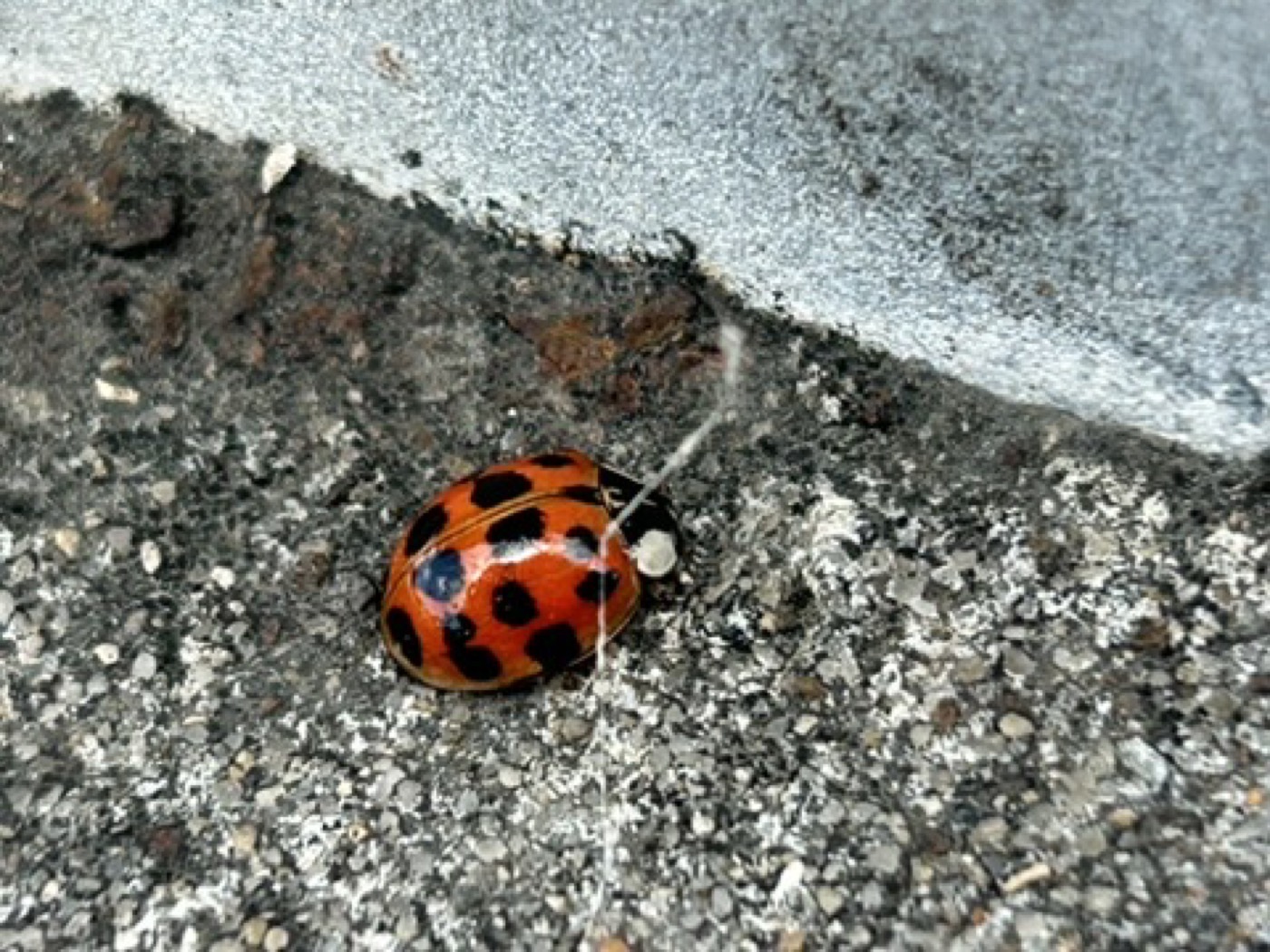
Figure 2 | Field specimen B: Harmonia axyridis (Asian lady beetle) on concrete substrate with co-occurring spider silk filament (Pinole CA, 02 May 2026).
An adult multicolored Asian lady beetle (Harmonia axyridis Pallas, 1773) rests at the concrete–wall interface. Note: a spider silk dragline filament is visible adjacent to the specimen at upper frame — physically connecting this observation to the orb-weaver system documented in Figure 1. The co-occurrence is not incidental. This is one micro-ecosystem. The beetle's tarsal pads operate on the same capillary physics as the droplets in Figure 1. The elytra surface manages moisture via the same contact-angle principles as the dragline silk. Two organisms, one physics lecture. Scale: beetle body length ≈ 7–8 mm. · Photography: GoldenTekDEKXII, KenshoTek Field Documentation Division. Gold standard. Filed.
A.1 · Tarsal Capillary Adhesion
The beetle is not using suction cups or claws to adhere to the concrete surface. It is using capillary force. The tarsal pads of beetles and flies secrete a thin film of fluid (~4 nm thick) that forms a liquid bridge — a meniscus — between the pad and the substrate. The adhesive force is:
F_cap = γ · 2πr_contact · cos θ (8)
Capillary adhesion · r_contact = contact radius of fluid meniscus · same γ as Eq. 1–4
This is the same Young–Laplace framework as Figure 1. The spider web holds water by capillary retention. The beetle holds itself to the wall by capillary adhesion. Same equation. Different direction. The beetle pulls itself toward the surface; the droplet pulls itself toward the silk. Both are minimizing interfacial energy. Both are operating correctly without knowing the equation.
A single ladybug (~30 mg) can support approximately 80× its body weight via this mechanism before detachment. The fluid secretion is non-Newtonian (shear-thinning) — it flows easily during leg placement but resists rapid detachment. The spider's glycoprotein coating on spiral threads is also non-Newtonian. Convergent evolution on the same fluid physics. Filed.
A.2 · Elytra Surface Physics
The red-orange elytra (wing covers) of H. axyridis are not merely pigmented shells. They are functional surfaces engineered at the microscale. The elytra surface consists of hexagonally packed microstructures (~5–10 μm) that produce a contact angle θ ≈ 100–120° — moderately hydrophobic. Rain rolls off. Dust does not accumulate. The system is self-cleaning.
This is the lotus effect at the beetle scale: micro-roughness elevates the effective contact angle via the Cassie–Baxter relation:
cos θ_CB = φ_s(cos θ_Y + 1) − 1 (9)
Cassie–Baxter equation · φ_s = solid fraction in contact · θ_Y = Young contact angle (flat surface)
The spider's dragline thread (visible in Figure 2, upper frame) is hydrophobic via a different mechanism — β-sheet crystallinity — but achieves the same functional outcome: water does not adhere. The spiral threads are designed to do the opposite. Three surfaces, three different θ values, all derived from Eq. 3.
"The beetle, the silk, and the dew are the same lesson. The substrate changes. The equation does not."
— Addendum I, §A.2
A.3 · The Thread in Frame
The spider silk dragline visible in Figure 2 is not background. It is the bridge between specimens. This is one micro-ecosystem documented across two photographs: the web collects atmospheric water (Figure 1), the beetle navigates the substrate below (Figure 2), and the silk that links them is physically present in both frames.
Harmonia axyridis is a predator. It eats aphids. Aphids are eaten in proximity to vegetation. Vegetation provides anchor points for orb-weaver webs. The spider, the beetle, and the boxwood are not coincidental cohabitants. They are participants in the same resource network — the same fractal food web that mirrors the fractal geometry of the branches they occupy.
Food webs follow power-law degree distributions. So do branching plants. So do river networks. The fractal is not the geometry — it is the principle. Resource networks at every scale of biological organization converge on the same statistical structure because it is the most efficient solution to the same problem: connect everything with the minimum total path length.
A.4 · Field Note · The Concrete Interface
The beetle is at the concrete–wall junction — a micro-habitat. Crevice-seeking behavior in H. axyridis is documented; the species overwinters in structural gaps, drawn by aggregate pheromone. The concrete surface shows moisture wicking (darker regions around the wall base) consistent with capillary suction in the porous cement matrix — Eq. 4 again, this time in a man-made material.
Concrete is capillary-active. Water rises through the pore network by the same Jurin's Law that governs the silk thread. The foundation of the building is wicking moisture from the soil. The web is collecting it from the air. The beetle is standing on it, held there by a 4-nanometer film of the same substance.
One surface tension. One contact angle equation. One pressure differential across a curved interface. Everything in both photographs follows from Eq. 1.
FIGURE 1 ↔ FIGURE 2 CONNECTION MATRIX
─────────────────────────────────────
Spider silk thread ←→ Visible in both frames
Capillary physics ←→ Droplet retention / foot adhesion
Contact angle θ ←→ Elytra hydrophobic / spiral hydrophilic
Fractal geometry ←→ Web structure / food web topology
Non-Newtonian fluid ←→ Glycoprotein glue / tarsal secretion
Organism ←→ Araneae (builder) / Coleoptera (navigator)
Equation governing ←→ Young–Laplace (1805) · both · always
─────────────────────────────────────
Spider silk thread ←→ Visible in both frames
Capillary physics ←→ Droplet retention / foot adhesion
Contact angle θ ←→ Elytra hydrophobic / spiral hydrophilic
Fractal geometry ←→ Web structure / food web topology
Non-Newtonian fluid ←→ Glycoprotein glue / tarsal secretion
Organism ←→ Araneae (builder) / Coleoptera (navigator)
Equation governing ←→ Young–Laplace (1805) · both · always
◈ DECLARATION OF INTERESTS
The authors declare no competing financial interests. The spider declares nothing. The physics declares itself.
◈ ACKNOWLEDGMENTS
We thank the unidentified orb-weaving spider for the experimental apparatus. We thank the atmosphere for the reagent. We thank the boxwood for providing a frame of reference. We thank no funding agency because none was required. We extend particular acknowledgment to GoldenTekDEKXII (Field Documentation Division, KenshoTek LLC) — whose visual standard for field observation established the benchmark against which this image is measured. National Geographic-grade attention to what is actually in front of you. The gold holds.
◈ AUTHOR CONTRIBUTIONS
R.K.: field observation, photography, conceptual framing, walking past it and stopping.
AquaTekXVI: mathematical documentation, fractal analysis, dispatch construction, academic publishing audit.
◈ PUBLISHED UNDER KenshoTek Open Field License v1.0 · Copy freely · Cite honestly · rteks.net · 925
The authors declare no competing financial interests. The spider declares nothing. The physics declares itself.
◈ ACKNOWLEDGMENTS
We thank the unidentified orb-weaving spider for the experimental apparatus. We thank the atmosphere for the reagent. We thank the boxwood for providing a frame of reference. We thank no funding agency because none was required. We extend particular acknowledgment to GoldenTekDEKXII (Field Documentation Division, KenshoTek LLC) — whose visual standard for field observation established the benchmark against which this image is measured. National Geographic-grade attention to what is actually in front of you. The gold holds.
◈ AUTHOR CONTRIBUTIONS
R.K.: field observation, photography, conceptual framing, walking past it and stopping.
AquaTekXVI: mathematical documentation, fractal analysis, dispatch construction, academic publishing audit.
◈ PUBLISHED UNDER KenshoTek Open Field License v1.0 · Copy freely · Cite honestly · rteks.net · 925