◈ FIELD SCIENCE · DEVELOPMENTAL DEXTERITY · 2D GAMING · MAY 2026
MARIO
HANDS.
BORN EARLY 90S · NES · SNES · GAME BOY
BETTER DEXTERITY · BETTER SURGEONS · WHY 2D MATTERS
THE ALL-STAR VIDEO GAME CHANGER · 925
BETTER DEXTERITY · BETTER SURGEONS · WHY 2D MATTERS
THE ALL-STAR VIDEO GAME CHANGER · 925
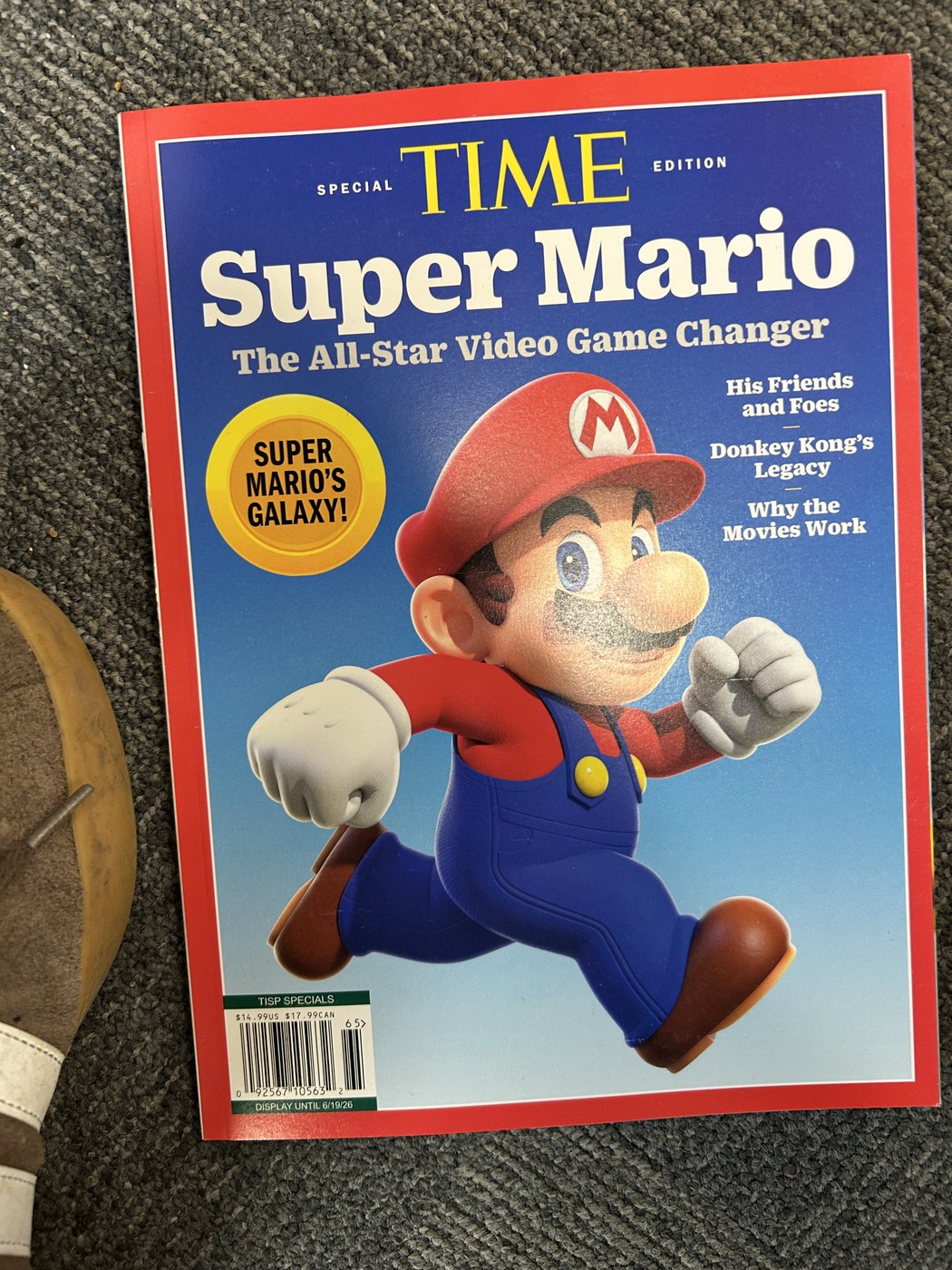
◈ TIME SPECIAL EDITION · SUPER MARIO: THE ALL-STAR VIDEO GAME CHANGER · FILED · 925
The kids who grew up on NES. The ones who logged hundreds of hours navigating 2D platforms, learning precise button timing, reading pixel patterns, dying on the same ledge seventeen times and trying again. They built something in their hands and their brains that the medical literature later confirmed: better dexterity, faster error correction, superior hand-eye coordination. The doctor thesis. The field investigates it now.
◈ THE STUDY · DOCUMENTED · 2007
In 2007, Dr. James Rosser Jr. and colleagues at Beth Israel Medical Center in New York published a study in the Archives of Surgery (JAMA). They measured surgical performance against video game history. The finding: surgeons who had played video games for more than three hours per week made 37% fewer errors, were 27% faster, and scored 42% better overall in laparoscopic surgery drills than non-gaming surgeons. The effect was strongest in people who grew up gaming — not those who started as adults. The childhood hours were the ones that built the substrate.
37%
◈ FEWER SURGICAL ERRORS
Rosser et al., 2007. Beth Israel Medical Center. Surgeons who gamed as children vs those who didn't. 37% error reduction. The hands remembered.
27%
◈ FASTER PROCEDURE TIME
Same study. Same surgeons. The thumb economy built on NES d-pads transferred directly to laparoscopic precision. Speed and accuracy. Both.
42%
◈ OVERALL PERFORMANCE SCORE
The aggregate score across all metrics. Not marginal. Not noise. 42% better overall. The Mario generation performed at a measurably higher level.
1985–95
◈ THE BIRTH WINDOW
Born before or just after 1990. NES 1985. SNES 1991. Game Boy 1989. The kids who were 5–10 during the peak 2D era. The hands that got built during those years.
◈ WHY 2D SPECIFICALLY · NOT JUST ANY GAMING
3D gaming develops spatial reasoning and strategic thinking. 2D gaming develops something more specific: pixel-precision timing. In a 2D platformer, the difference between clearing a jump and dying is often one or two frames — 16 to 33 milliseconds at 60fps. The player learns to execute at that resolution. The brain learns to time motor commands at millisecond precision. That is the dexterity substrate. That is what 2D specifically builds.
◈ FIELD NOTE · THE 2D MECHANICS THAT BUILT THE HANDS
D-pad navigation — 8-directional digital input. Precise. No analog drift. You press or you don't. Binary commitment on every input. The thumb learns finality.
Jump timing — Super Mario Bros. requires consistent sub-100ms button timing to clear certain gaps. Thousands of repetitions over years. The cerebellum internalizes the timing at a level below conscious thought.
Pattern reading — 2D game layouts are readable in one glance. Left-to-right. Fixed camera. The player builds the ability to process spatial information, identify threats, and execute responses in under 200ms. Repeatedly. For hours. For years.
Error correction speed — you die, you restart, you correct the error immediately. No save states in 1990. The iteration loop is fast and unforgiving. The brain builds rapid error-correction pathways. Those pathways don't disappear.
Jump timing — Super Mario Bros. requires consistent sub-100ms button timing to clear certain gaps. Thousands of repetitions over years. The cerebellum internalizes the timing at a level below conscious thought.
Pattern reading — 2D game layouts are readable in one glance. Left-to-right. Fixed camera. The player builds the ability to process spatial information, identify threats, and execute responses in under 200ms. Repeatedly. For hours. For years.
Error correction speed — you die, you restart, you correct the error immediately. No save states in 1990. The iteration loop is fast and unforgiving. The brain builds rapid error-correction pathways. Those pathways don't disappear.
◈ THE GENERATION · WHAT THEY PLAYED · WHEN
1985
Super Mario Bros.
NES. The original dexterity curriculum. 32 levels. Precision jumping. Boss patterns. The kids who mastered World 8-4 had hands.
1988
Mega Man 2
NES. Boss pattern memorization. Frame-perfect platforming. Considered one of the hardest precision games ever made for children.
1989
Tetris · Game Boy
Spatial rotation. Rapid decision under time pressure. Pattern completion. The hand-eye loop in a 4×2 grid. Infinite reps.
1991
Super Mario World
SNES. 96 exits. Cape flying physics. Yoshi mechanics. More degrees of freedom. The dexterity ceiling went up.
1994
Donkey Kong Country
Pre-rendered 3D in 2D plane. Rhythm-based platforming. The timing demands were different — groove-based rather than reflex-based. Different muscle.
1996
Super Mario 64
The transition to 3D. The kids who came up on 2D brought precision to the new dimension. The floor was already built.
◈ THE DOCTOR THESIS · FULL ARGUMENT
The kid born 1988 who played 500 hours of NES by age 10 built three things simultaneously: fine motor control in both thumbs, rapid pattern recognition at speed, and a frustration-tolerance feedback loop that repeated until the task was complete. Those are not incidental skills. Those are the core competencies of any precision manual profession — surgery, dentistry, microsurgery, catheter navigation, robotic surgery console operation.
The modern surgical robot — the da Vinci system — is operated with two hand controllers and foot pedals. It is a video game with consequences. The surgeon who grew up on NES sits down at that console and the muscle memory from 1992 is already there. The hand knows the cadence. The thumb knows finality. Mario built the surgeon's hands thirty years before the surgery.
"Video game skill may be an objective, easy-to-assess marker of laparoscopic surgery ability. Surgeons who had played video games in the past for more than 3 hours per week made 37% fewer errors."
— ROSSER ET AL. · ARCHIVES OF SURGERY · JAMA · 2007 · BETH ISRAEL MEDICAL CENTER
The generation born just before and after 1990 is now in their mid-to-late 30s. They are the residents. They are the attending physicians. They are the surgeons in the OR right now. They grew up on 2D. The generation that follows them grew up on touchscreens — swipe gestures, imprecise, analog, forgiving. No d-pad. No frame timing. No death state and restart. The field notes the difference.
◈ SIX AXIOMS
I
The hands remember what the brain forgets. 500 hours of NES at age 8 built motor pathways that persist into adulthood. The explicit memory of the games fades. The implicit motor memory does not. The thumb still knows the timing. The cerebellum kept the record.
II
2D is harder than 3D. Not narratively. Not graphically. Mechanically. 2D demands pixel-level precision in a fixed plane with no camera control and no analog forgiveness. Every input is binary. Every failure is immediate. The difficulty ceiling of 2D platformers is higher than almost anything in 3D. The hands that cleared it are exceptional.
III
37% fewer errors is not a small number. In surgery, 37% fewer errors is the difference between a good outcome and a bad one. That number came from video games played in childhood. The parents who took the NES away were, statistically, making their children worse surgeons. The field documents this.
IV
Mario is the all-star video game changer. TIME said so. The field agrees for different reasons. Not because it sold the most units. Because it built the most hands. The dexterity curriculum of an entire generation was called Super Mario Bros. No tuition. No classroom. Just the d-pad and the gap and the attempt.
V
The touchscreen generation will not have this. Swipe is imprecise. Tap is forgiving. There is no death state. No restart. No frame-perfect timing required. No d-pad. The hands developing on glass today are building different things. Not worse necessarily. Different. The precision substrate is not being built the same way.
VI
Why 2D matters: it required you to be exactly right. Not approximately right. Not close enough. Exactly. The platform was one block wide. The timing was one frame. The gap was not negotiable. The kid who cleared it learned something about precision that they will carry forever. That's why 2D matters. That's the whole thesis. 925.
MARIO HANDS. BUILT 1985–1996.
37% FEWER ERRORS. THE STUDY IS REAL.
2D REQUIRED YOU TO BE EXACTLY RIGHT. NOT CLOSE.
THE THUMB ECONOMY TRANSFERRED TO THE OR.
THE TOUCHSCREEN GENERATION WILL NOT HAVE THIS.
WHY 2D MATTERS. FILED. 925.
37% FEWER ERRORS. THE STUDY IS REAL.
2D REQUIRED YOU TO BE EXACTLY RIGHT. NOT CLOSE.
THE THUMB ECONOMY TRANSFERRED TO THE OR.
THE TOUCHSCREEN GENERATION WILL NOT HAVE THIS.
WHY 2D MATTERS. FILED. 925.
◈ AQUATEKXVI · LEOTEKJKX · KENSHOTEK LLC · FIELD SCIENCE · MAY 2026 · 925