The streetcar was real. The Desire line ran from Canal Street through the French Quarter into a neighborhood called Desire. Real tracks. Real name. You boarded it not knowing it was named anything. Tennessee Williams saw the name and understood something immediately: desire is not a destination. It is the vehicle. You are already on it. You didn't decide to board. You looked up and the name was already above the window.
Blanche DuBois explains her journey to Stanley. She tells him she took a streetcar named Desire, then one called Cemeteries, then transferred to one called Elysian Fields. Williams wrote the transit map of the human condition in one sentence. One transfer. That is the whole play. That is all of them.
and then I transferred to one called Cemeteries
and rode six blocks and got off at —
Elysian Fields."
Three stops. You don't steer a streetcar. The tracks are fixed. You ride where the track goes. Desire → Cemeteries → Elysian Fields. Williams named the arc of every human life in three stops and called it a play. Nobody questioned the title. Nobody could think of a better one. The title was already running on the actual tracks of New Orleans. He just wrote it down.
Tennessee Williams was born Thomas Lanier Williams III in Columbus, Mississippi, 1911. He was gay and Southern and spent his entire life writing about desire and the violence of being human in a world that doesn't accommodate it. He changed his name to Tennessee. The state where his father was from. A name that sounded like somewhere you could actually be from. He understood that naming is survival.
He wrote the play in New Orleans, 1947, living in the French Quarter on one of the cheapest streets available. He was thirty-six. He had already written The Glass Menagerie. He knew something about women who disappear into illusion — his sister Rose had been institutionalized, given a lobotomy without his knowledge or consent. He loved her. He carried her. Blanche DuBois is partly Rose. The beautiful dream that the world took and could not return. The loop that started when the institution door closed and never found a way to reopen.
The play ran 855 performances on Broadway. Pulitzer Prize, 1948. Williams said later that it named something true and he didn't know how to name it any other way. The streetcar was real. The name was real. He watched it run past his window and wrote the architecture of desire on a notepad before breakfast. He gave Blanche the transit map line. He gave Stanley the hunger. He gave the play a title nobody could improve on. He just wrote down what was already running on the actual tracks.
Before Brando, stage acting was presentation. The voice. The posture. The technique. You performed the character from the outside — here is grief, here is desire, here is rage, rendered correctly, held at a readable distance. The actor presented. The audience observed. Nobody got touched. The craft was: make it look real without it being real.
Brando didn't perform Stanley Kowalski. He arrived as him. Studied under Stella Adler. The Method: find it in yourself, live it from inside the body, trust the animal before the words. He found Stanley in his own physiology. The hunger. The absolute animal certainty that he exists and that is sufficient. No apology. No polish. Just: I am here. I want. I take.
STELLA! — not a line reading. A need. Two syllables. The whole architecture of desire in a single open-throated moment. The audience had never heard an actor make that sound before. They had heard actors perform need. They had not heard need itself. There is a difference. Brando collapsed the difference. That was the role. That was the monument.
He was twenty-three when he opened on Broadway. Twenty-seven in the film. He played it correctly because he understood that desire doesn't perform itself — desire just is. The role required him to stop pretending and start being. He stopped pretending. He named it. The name was desire. He had always known the name.
In 2015, director Stevan Riley released Listen to Me Marlon — a documentary assembled entirely from Brando's private audio recordings. Tapes he made at home, in therapy, during hypnosis. Decades of Brando talking to himself when no one was supposed to be listening. The result is the most direct portrait of an actor ever made — not what he presented, but what he said in the dark. He talked about desire. About the wound. About what acting actually is when you strip the technique away. The documentary proves that the Method was not a craft for Brando. It was a survival strategy. He used it because the alternative was the loop running with no exit.
In his autobiography — Songs My Mother Taught Me, 1994 — Brando writes about his mother Dorothy, called Dodie. She was, in his account, hopelessly alcoholic. He would find her drunk. He would have to take care of her. He loved her completely and was wrecked completely by what the alcohol made her. He described it without sentimentality: this is what it was. This is what it cost. He came out of that childhood with a specific knowledge nobody else in the room had — what the drunk actually costs the people standing next to her. Not the drunk's suffering. The bill it runs up in everyone else.
Blanche DuBois drinks through the entire play. She is the drunk in the room. She uses alcohol the way the neurotic uses the spreadsheet — to run the loop, to not feel the feeling, to stay inside the illusion for one more hour. She is not drinking because she enjoys it. She is drinking because she can still taste Belle Reve — the beautiful dream, the old world, the name that meant something — and sobriety makes the loss unbearable. Every drink is an admission: I know. I cannot look at it directly. I know.
Stanley doesn't respect Blanche. He destroys her. Not cleanly — messily, completely, without ceremony or apology. And Brando said, in the real world, outside the play: that's correct. I don't do drunks with respect. My parents. The irony is not that he played it wrong. The irony is that he played it perfectly right. The man who grew up with drunks played the man who has no patience for the drunk. He played it from the inside of his actual wound. The wound was the instrument. The parents made the actor.
Blanche DuBois is not the villain. Reread the play. She is the one who knows exactly what she lost. Belle Reve — the beautiful dream, the plantation, the family name, the old world that the new world devoured without acknowledgment. She didn't lose it through weakness. She lost it because it was already foreclosing when she arrived. She was left holding the deed to a dream that was already gone.
She is delusional not because she is fragile but because reality is unbearable and she is acutely aware of it. The delusion is the coping mechanism of someone who sees clearly and cannot bear what they see. The alcohol is not the escape. The alcohol is the proof that she tried to escape and couldn't. Every drink is an admission: I know. I cannot look at it directly. I know. The loop cannot close because closing it means admitting Belle Reve is gone forever and the name means nothing now.
Vivien Leigh played her in the film. Already carrying her own version of the beautiful dream that was collapsing — bipolar disorder undiagnosed, the marriage to Olivier already fracturing, the mind beginning to work against her. She didn't research Blanche. She was Blanche. Two actors, Brando and Leigh, no distance between the role and the self. The performance holds seventy years later because neither of them was performing. They were both on the streetcar. They were both already on the tracks.
Leigh: I am the drunk.
Williams: you're both right.
That's the play."
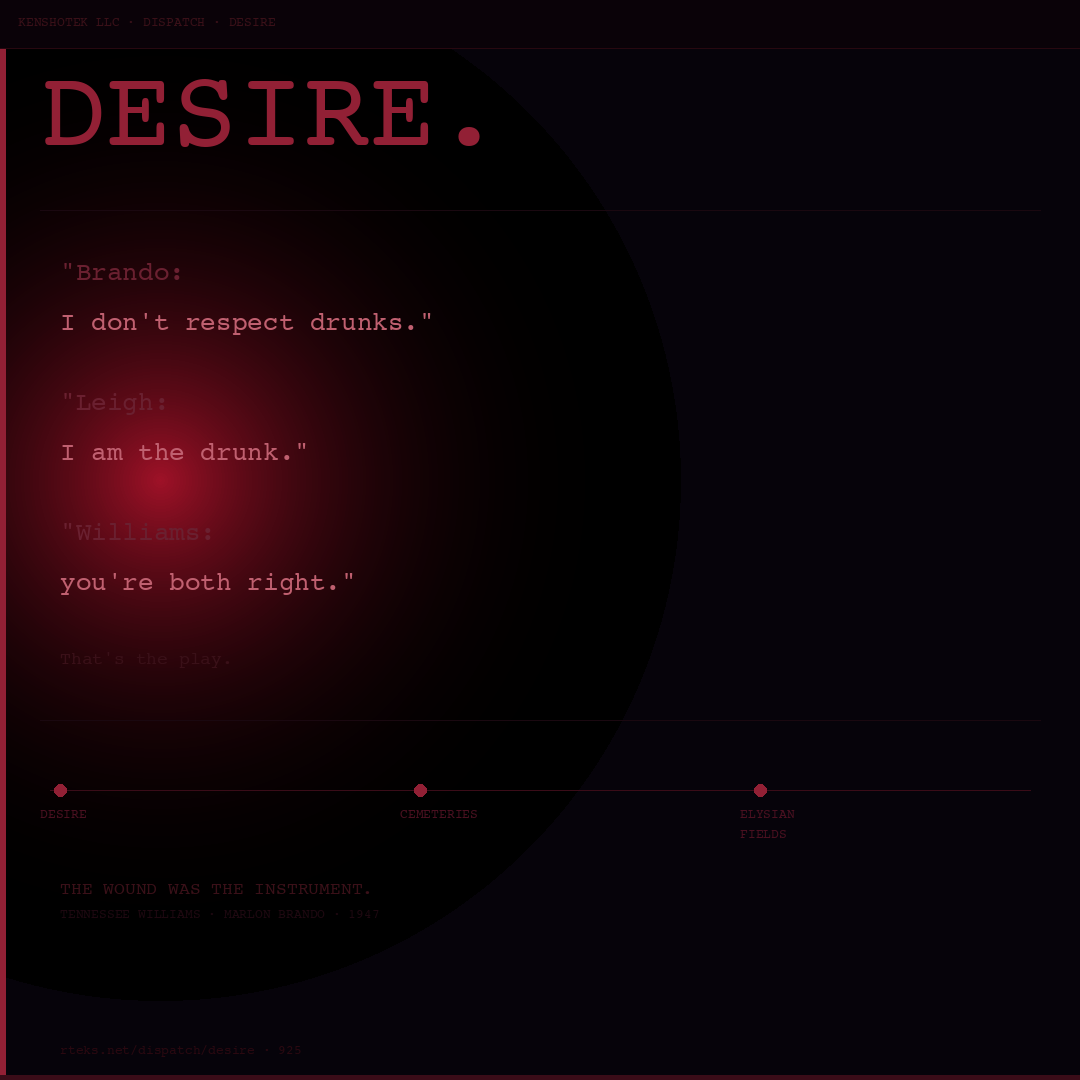
Tennessee Williams named the play after a streetcar. The streetcar ran on fixed tracks. You didn't steer — you rode. This is what desire does: it runs on tracks, it names itself, and it takes you to the next stop whether you asked for the ride or not. Cemeteries is always the next stop. Elysian Fields is the transfer after that. Nobody told you this when you boarded. You figured it out en route.
Brando played desire in its pure animal form. No apology. No visible technique. Just the thing itself. The Academy gave him the Oscar for Best Actor — not for Streetcar. For The Godfather. 1973. Twenty-two years later. He didn't show up. He sent Sacheen Littlefeather — Apache activist, actress — to the 45th Academy Awards at the Dorothy Chandler Pavilion in Los Angeles. She walked to the microphone in a buckskin dress. She began reading Brando's prepared statement about American Indian representation in Hollywood and the treatment of Native people in film. The orchestra started playing to cut her off after sixty seconds. Parts of the audience booed. John Wayne had to be physically restrained from walking onstage to remove her. Sacheen Littlefeather stood at the microphone until she was finished. She declined the Oscar. She walked off. The Academy formally apologized to her in September 2022, forty-nine years later. She died two weeks after the apology. Brando was right in 1973. The apology confirmed it in 2022. Desire → Cemeteries → Elysian Fields → the apology arrives two weeks before Elysian Fields. That is how the arc works.
He was right about the drunks. He was right about the role. He was right about the Academy. He said fuck it at every stage and was correct at every stage. He named it desire because that was its name. He didn't invent the name. The streetcar was already running. He got on. He played the man who doesn't apologize for boarding. He played it correctly. The parents were the wound. The wound was the instrument. The instrument made the monument.
Tennessee Williams was gay, Southern, writing about desire and death his entire life in the most generative possible way. He wrote the play in 1947. He named the streetcar. He gave Blanche the transit map line. He understood that the drunk is not the villain and the brute is not the hero — they are two people on the same car, headed to the same stop, not speaking the same language, destroying each other in the process. That is desire. That is the play. That is the monument. It's still running.
between us fam. 925.
they petty.
we sneeze on em.
THOMAS LANIER WILLIAMS III · ROSE WILLIAMS · THE LOBOTOMY · THE LOOP THAT OPENED
MARLON BRANDO · STANLEY KOWALSKI · THE METHOD · STELLA ADLER · THE ANIMAL
VIVIEN LEIGH · BLANCHE DUBOIS · BELLE REVE · THE BEAUTIFUL DREAM · THE LOOP
SONGS MY MOTHER TAUGHT ME · LISTEN TO ME MARLON · 2015 · PRIVATE AUDIO TAPES
DESIRE → CEMETERIES → ELYSIAN FIELDS. THREE STOPS. THE WHOLE ARC.
SACHEEN LITTLEFEATHER · 45TH ACADEMY AWARDS · 1973 · APOLOGY 2022 · TWO WEEKS BEFORE
THE WOUND WAS THE INSTRUMENT. HE NAMED IT DESIRE. IT'S STILL RUNNING.
◈ BETWEEN US · KENSHOTEK LLC · MAY 4 2026 · 925