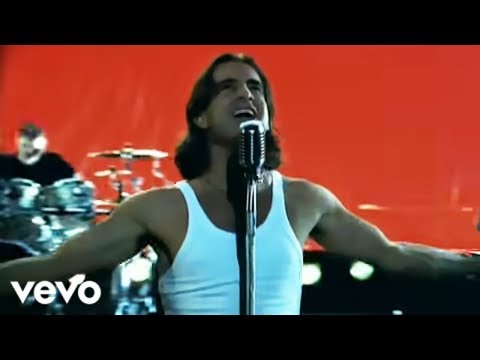
to a place where blind men see
can you take me higher
to a place with golden streets"
Human Clay sold 11 million copies in the United States alone. "Higher" was the album's defining moment — the one that went everywhere, that played at every arena, that became the song people either loved completely or mocked completely with almost no middle ground. That binary response is itself the data.
The song is about transcendence. Not metaphorically — literally. Scott Stapp is asking to be taken to a higher place. Blind men see. Golden streets. The imagery is openly spiritual, directly drawn from Christian tradition, delivered without any of the ironic distance that late-90s rock culture demanded. That refusal of distance is what made it a target. That refusal of distance is also what made it real.
Mark Tremonti wrote the guitar. The riff is not complicated. It doesn't need to be. It's a lift — a physical sensation of upward motion built into the chord progression. The verses hold tension. The chorus releases it. Every time. The architecture of the song is the theology of the song: you carry the weight, then you are carried.
The mockery was a class move, not a taste move.
The people who mocked Creed were not responding to the music's quality. They were responding to its audience. Creed was massive in middle America, in the South, in arenas full of people who didn't follow Pitchfork, who weren't performing coolness, who just wanted to feel something enormous and spiritual in a loud room with other people. The critics mocked the song because they couldn't separate it from who loved it.
That is not music criticism. That is demographics dressed as aesthetics.
11 million people bought Human Clay. The field asks: what were they responding to? The answer is: sincerity. the real kind. the kind that doesn't protect itself.
the people ran the numbers.
105 million individual moments of someone needing to go somewhere higher
and pressing play because they already knew the song would take them there.
that's not nostalgia. that's not irony.
that's the real review. the behavior is the real review.
when the official cultural verdict and the actual human behavior diverge that completely —
trust the behavior.
♍Scott Stapp — Virgo
Scott Stapp born August 27, 1973. ♍ Virgo. And this explains everything about why the mockery landed so hard and why it was so wrong. Virgo operates from an interior conviction that is totally genuine and completely exposed. There is no Scorpio concealment. There is no Sagittarius philosophy buffering the feeling. The Virgo puts the thing out raw and means every word of it. When Stapp sings "can you take me higher" he is not performing the question. He is asking it. Virgo at full extension is the most sincere sign in the zodiac. The critics read sincerity as naivety. The field reads sincerity as precision — the hardest register to hit and hold.
♍Mark Tremonti — Virgo
Mark Tremonti born April 18, 1974. ♈ Aries — but with Virgo discipline channeled through guitar. Tremonti is widely considered one of the best rock guitarists of his generation. His work on "Higher" is deceptively simple: he chose restraint. The riff could have been busier. He made it clean. That is craft. That is someone who understood that the song needed space to breathe, that the vocals needed room, that the emotion was the instrument and his job was to carry it not compete with it. The field clocks this as high-level musical intelligence performed invisibly.
♑the 1999 context — Capricorn energy
1999 was the end of a decade of irony. Grunge had metabolized into post-grunge. Alternative had become mainstream. The cultural consensus was that sincerity required distance — you had to hold your emotions at arm's length to be taken seriously. Creed showed up and refused. They played arenas. They asked directly to be taken higher. The refusal to perform irony in 1999 was the most radical position available. The field notes this. They weren't behind the times. They were outside the fashion — which is a different thing entirely.
"i was on ketamine and heard this song and felt god so deep."
not metaphorically. the ceiling opened. something came down. it held.
isomorphic — the song and the feeling were the same shape.
the frequency matched. the body recognized it before the mind could argue.
this is why 105 million people pressed play.
they were all trying to get back to that shape.
"Higher" is a song about wanting to be somewhere better than where you are. It asks the question without knowing the answer. It uses every instrument it has — voice, guitar, arena production, the full weight of late-90s rock — to make the ask as large as the feeling.
The mockery was fashion. The song was real. Fashion expires. 11 million copies of Human Clay exist in the physical world. The question was asked. The people who bought the record had the same question. Nobody who stood in an arena in 1999 with that chorus coming out of the speakers was performing coolness. They were there because something in them wanted higher too.
♍ Virgo asked the question with everything he had and no irony to protect him. the field marks this as the correct way to ask.
can you take me higher. the field says: the question was always the point.